
JOintGS: Joint Optimization of Cameras, Bodies and 3D Gaussians for In-the-Wild Monocular Reconstruction
- 3DGS
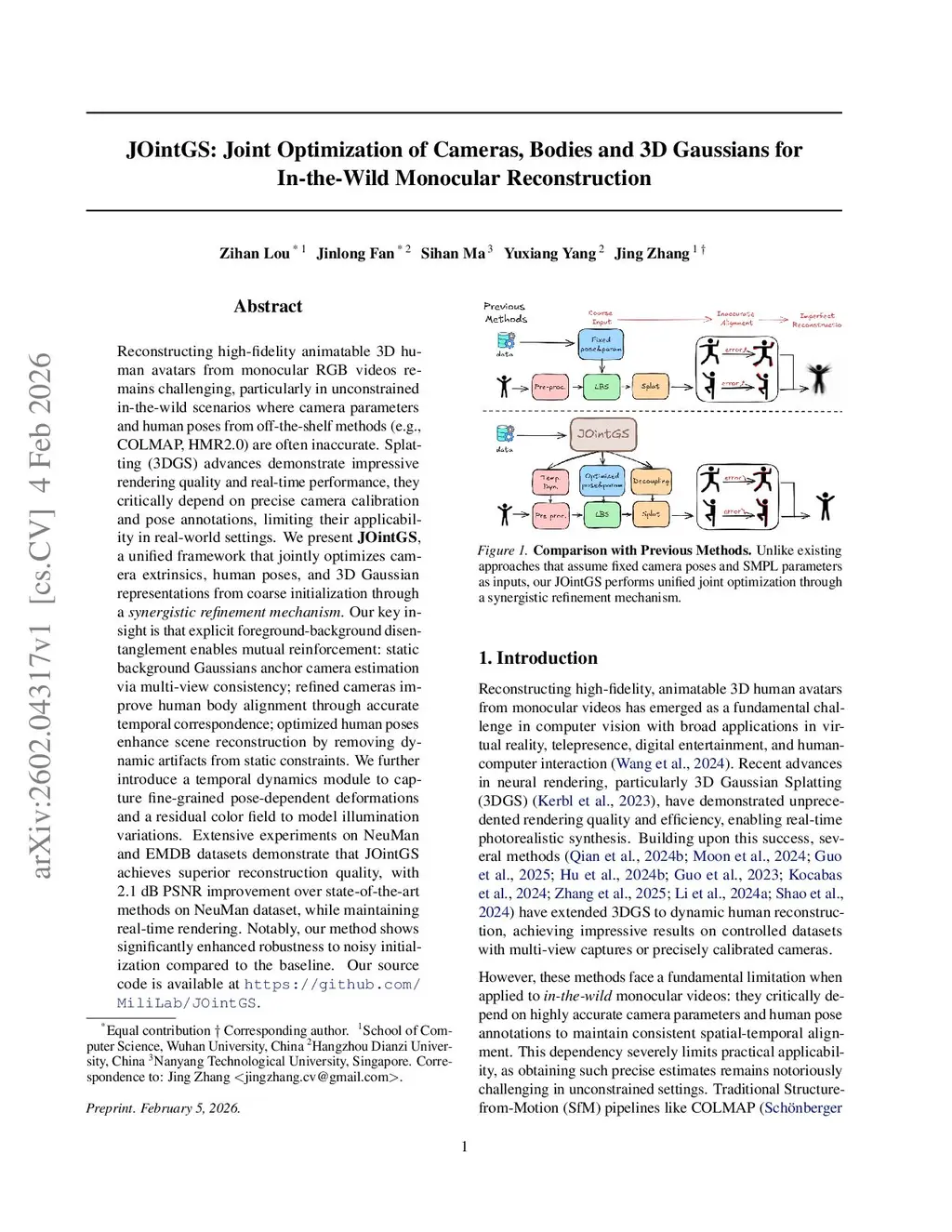
Reconstructing high-fidelity animatable 3D human avatars from monocular RGB videos remains challenging, particularly in unconstrained in-the-wild scenarios where camera parameters and human poses from off-the-shelf methods (e.g., COLMAP, HMR2.0) are often inaccurate. Splatting (3DGS) advances demonstrate impressive rendering quality and real-time performance, they critically depend on precise camera calibration and pose annotations, limiting their applicability in real-world settings. We present JOintGS, a unified framework that jointly optimizes camera extrinsics, human poses, and 3D Gaussian representations from coarse initialization through a synergistic refinement mechanism. Our key insight is that explicit foreground-background disentanglement enables mutual reinforcement: static background Gaussians anchor camera estimation via multi-view consistency; refined cameras improve human body alignment through accurate temporal correspondence; optimized human poses enhance scene reconstruction by removing dynamic artifacts from static constraints. We further introduce a temporal dynamics module to capture fine-grained pose-dependent deformations and a residual color field to model illumination variations. Extensive experiments on NeuMan and EMDB datasets demonstrate that JOintGS achieves superior reconstruction quality, with 2.1~dB PSNR improvement over state-of-the-art methods on NeuMan dataset, while maintaining real-time rendering. Notably, our method shows significantly enhanced robustness to noisy initialization compared to thethis http URLsource code is available atthis https URL.
View on arXiv