
ImmuVis: Hyperconvolutional Foundation Model for Imaging Mass Cytometry
- VLM
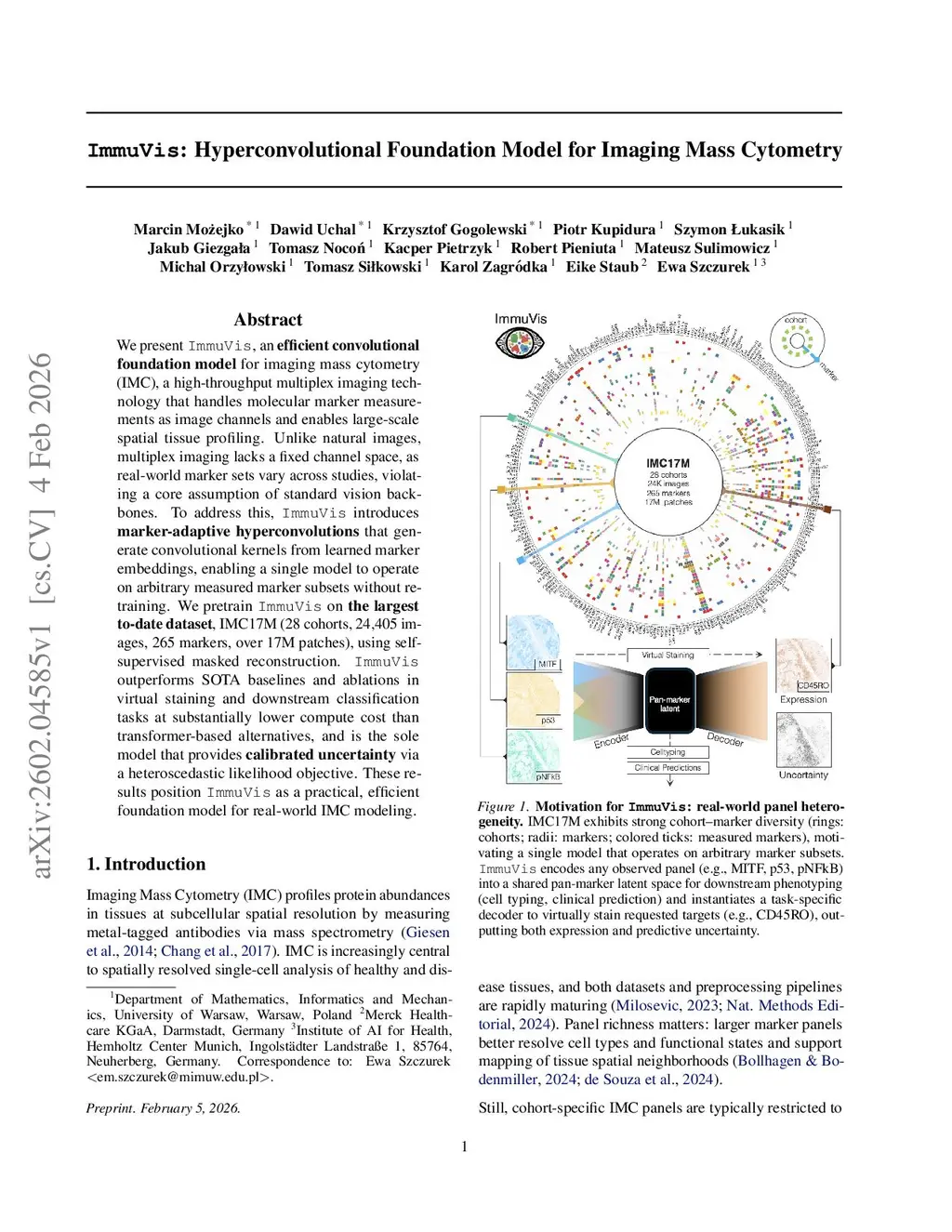
We present ImmuVis, an efficient convolutional foundation model for imaging mass cytometry (IMC), a high-throughput multiplex imaging technology that handles molecular marker measurements as image channels and enables large-scale spatial tissue profiling. Unlike natural images, multiplex imaging lacks a fixed channel space, as real-world marker sets vary across studies, violating a core assumption of standard vision backbones. To address this, ImmuVis introduces marker-adaptive hyperconvolutions that generate convolutional kernels from learned marker embeddings, enabling a single model to operate on arbitrary measured marker subsets without retraining. We pretrain ImmuVis on the largest to-date dataset, IMC17M (28 cohorts, 24,405 images, 265 markers, over 17M patches), using self-supervised masked reconstruction. ImmuVis outperforms SOTA baselines and ablations in virtual staining and downstream classification tasks at substantially lower compute cost than transformer-based alternatives, and is the sole model that provides calibrated uncertainty via a heteroscedastic likelihood objective. These results position ImmuVis as a practical, efficient foundation model for real-world IMC modeling.
View on arXiv