
DiTS: Multimodal Diffusion Transformers Are Time Series Forecasters
- DiffMAI4TS
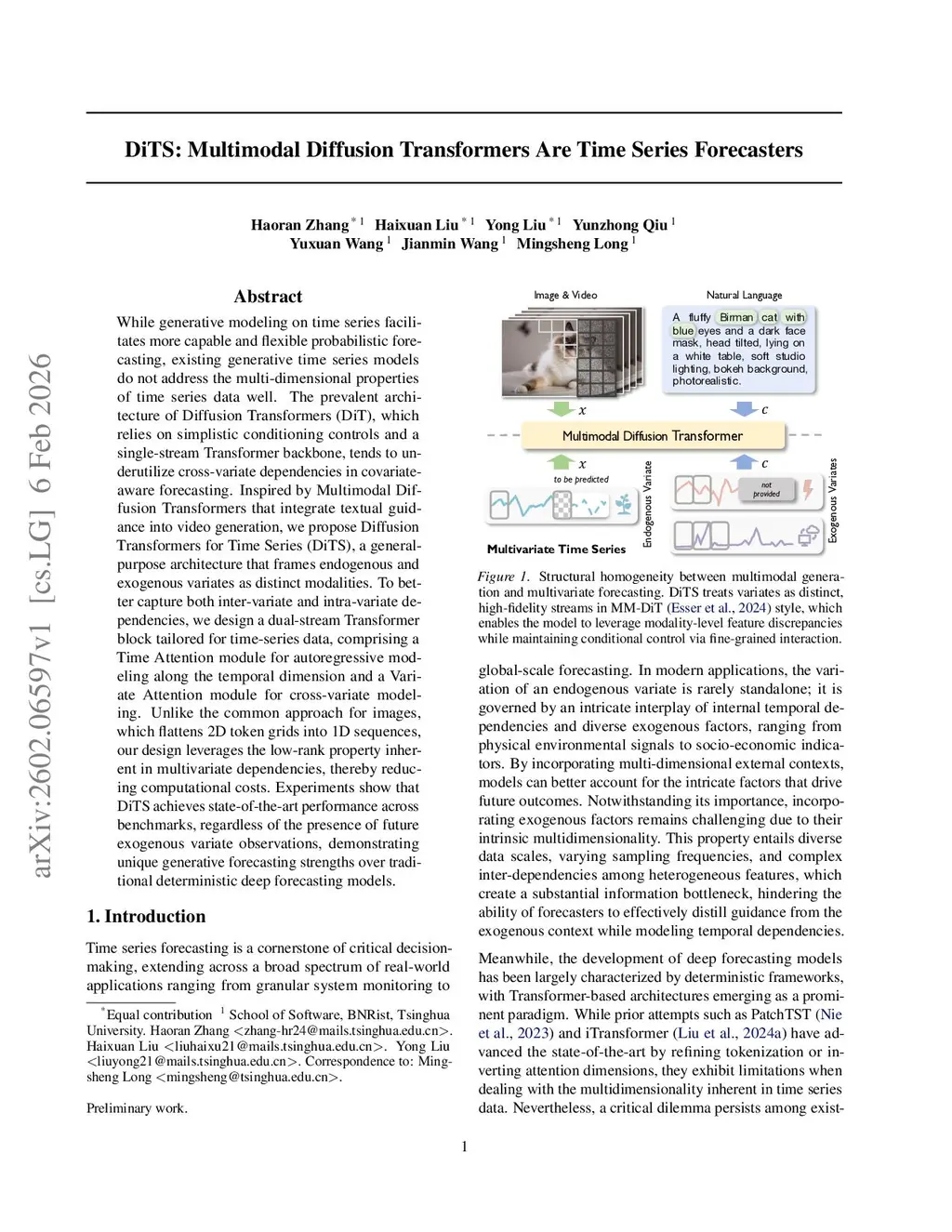
While generative modeling on time series facilitates more capable and flexible probabilistic forecasting, existing generative time series models do not address the multi-dimensional properties of time series data well. The prevalent architecture of Diffusion Transformers (DiT), which relies on simplistic conditioning controls and a single-stream Transformer backbone, tends to underutilize cross-variate dependencies in covariate-aware forecasting. Inspired by Multimodal Diffusion Transformers that integrate textual guidance into video generation, we propose Diffusion Transformers for Time Series (DiTS), a general-purpose architecture that frames endogenous and exogenous variates as distinct modalities. To better capture both inter-variate and intra-variate dependencies, we design a dual-stream Transformer block tailored for time-series data, comprising a Time Attention module for autoregressive modeling along the temporal dimension and a Variate Attention module for cross-variate modeling. Unlike the common approach for images, which flattens 2D token grids into 1D sequences, our design leverages the low-rank property inherent in multivariate dependencies, thereby reducing computational costs. Experiments show that DiTS achieves state-of-the-art performance across benchmarks, regardless of the presence of future exogenous variate observations, demonstrating unique generative forecasting strengths over traditional deterministic deep forecasting models.
View on arXiv