
Haptically Experienced Animacy Facilitates Emotion Regulation: A Theory-Driven Investigation
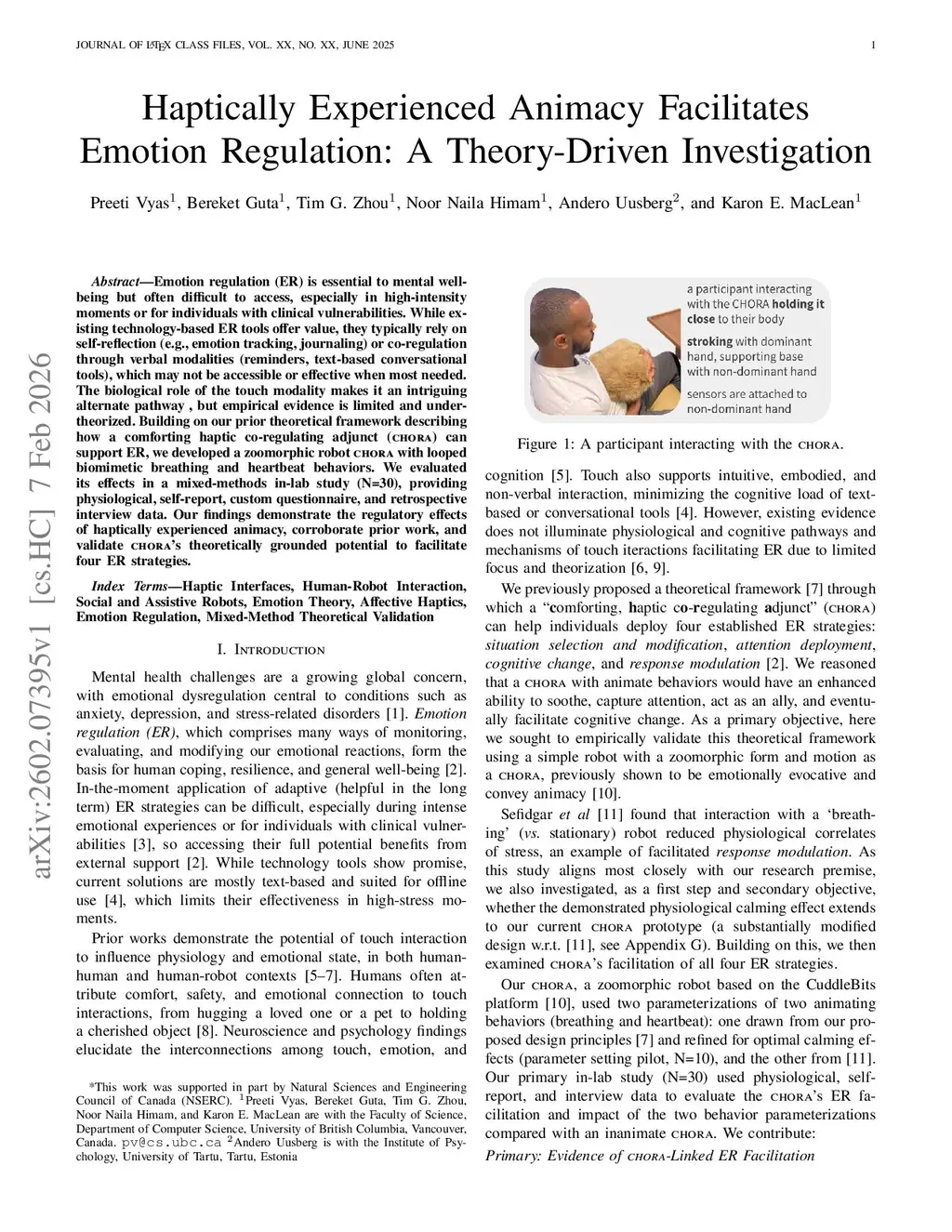
Emotion regulation (ER) is essential to mental well-being but often difficult to access, especially in high-intensity moments or for individuals with clinical vulnerabilities. While existing technology-based ER tools offer value, they typically rely on self-reflection (e.g., emotion tracking, journaling) or co-regulation through verbal modalities (reminders, text-based conversational tools), which may not be accessible or effective when most needed. The biological role of the touch modality makes it an intriguing alternate pathway, but empirical evidence is limited and under-theorized. Building on our prior theoretical framework describing how a comforting haptic co-regulating adjunct (CHORA) can support ER, we developed a zoomorphic robot CHORA with looped biomimetic breathing and heartbeat behaviors. We evaluated its effects in a mixed-methods in-lab study (N=30), providing physiological, self-report, custom questionnaire, and retrospective interview data. Our findings demonstrate the regulatory effects of haptically experienced animacy, corroborate prior work, and validate CHORA's {theoretically grounded} potential to facilitate four ER strategies.
View on arXiv