
LLMs Know More About Numbers than They Can Say
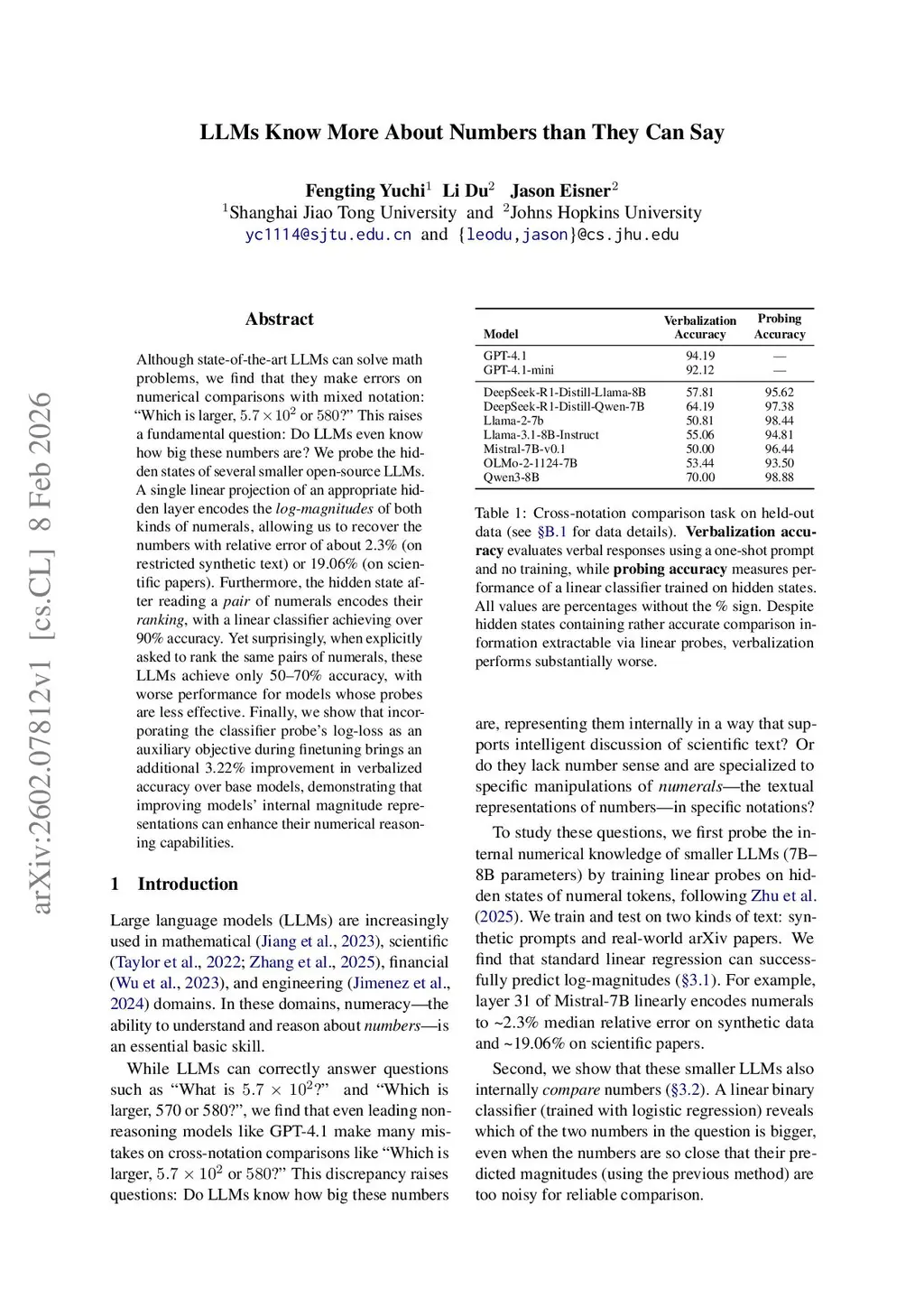
Although state-of-the-art LLMs can solve math problems, we find that they make errors on numerical comparisons with mixed notation: "Which is larger, or ?" This raises a fundamental question: Do LLMs even know how big these numbers are? We probe the hidden states of several smaller open-source LLMs. A single linear projection of an appropriate hidden layer encodes the log-magnitudes of both kinds of numerals, allowing us to recover the numbers with relative error of about 2.3% (on restricted synthetic text) or 19.06% (on scientific papers). Furthermore, the hidden state after reading a pair of numerals encodes their ranking, with a linear classifier achieving over 90% accuracy. Yet surprisingly, when explicitly asked to rank the same pairs of numerals, these LLMs achieve only 50-70% accuracy, with worse performance for models whose probes are less effective. Finally, we show that incorporating the classifier probe's log-loss as an auxiliary objective during finetuning brings an additional 3.22% improvement in verbalized accuracy over base models, demonstrating that improving models' internal magnitude representations can enhance their numerical reasoning capabilities. Our code is available atthis https URL.
View on arXiv