
ARO: A New Lens On Matrix Optimization For Large Models
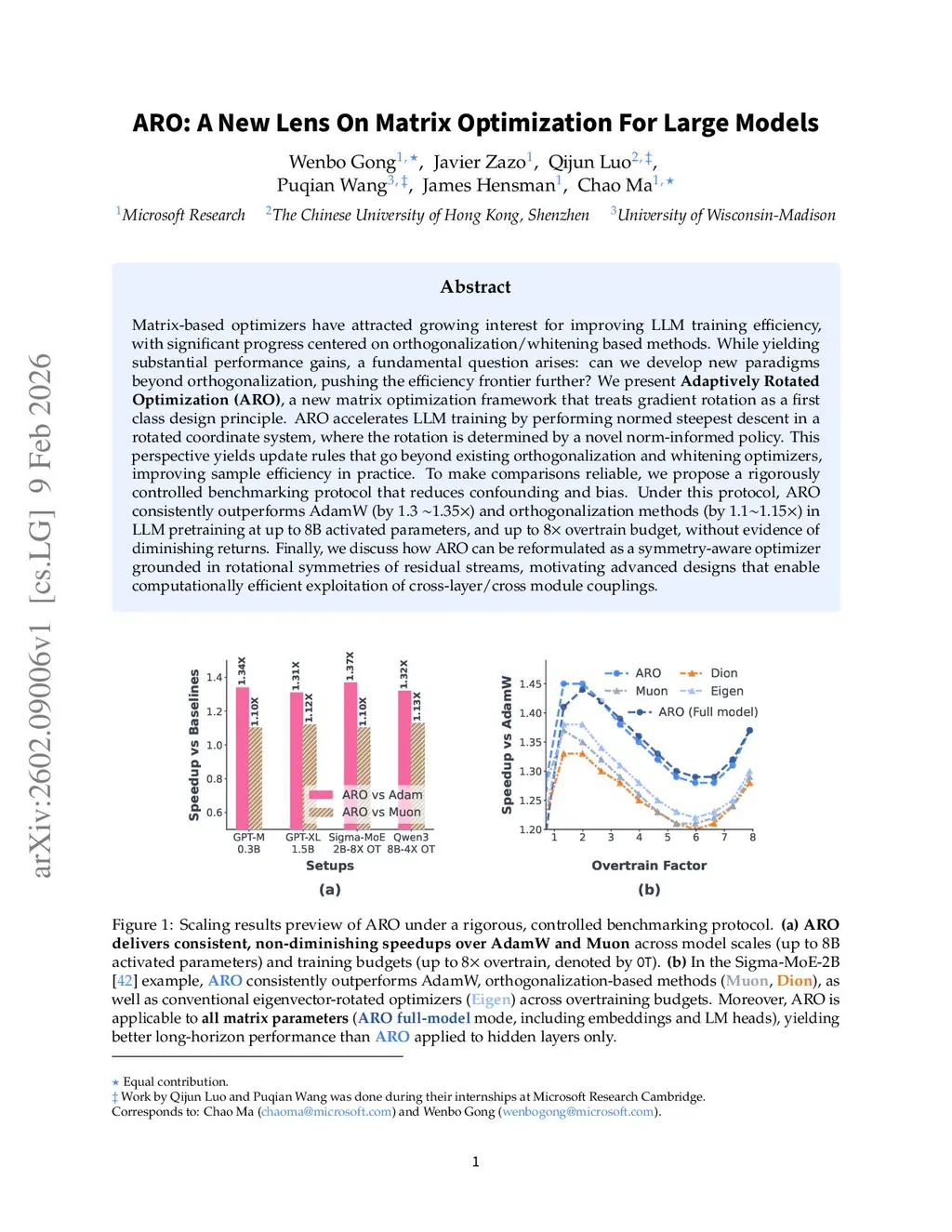
Matrix-based optimizers have attracted growing interest for improving LLM training efficiency, with significant progress centered on orthogonalization/whitening based methods. While yielding substantial performance gains, a fundamental question arises: can we develop new paradigms beyond orthogonalization, pushing the efficiency frontier further? We present \textbf{Adaptively Rotated Optimization (ARO}, a new matrix optimization framework that treats gradient rotation as a first class design principle. ARO accelerates LLM training by performing normed steepest descent in a rotated coordinate system, where the rotation is determined by a novel norm-informed policy. This perspective yields update rules that go beyond existing orthogonalization and whitening optimizers, improving sample efficiency in practice. To make comparisons reliable, we propose a rigorously controlled benchmarking protocol that reduces confounding and bias. Under this protocol, ARO consistently outperforms AdamW (by 1.3 1.35) and orthogonalization methods (by 1.11.15) in LLM pretraining at up to 8B activated parameters, and up to overtrain budget, without evidence of diminishing returns. Finally, we discuss how ARO can be reformulated as a symmetry-aware optimizer grounded in rotational symmetries of residual streams, motivating advanced designs that enable computationally efficient exploitation of cross-layer/cross module couplings.
View on arXiv