
Predicting magnetism with first-principles AI
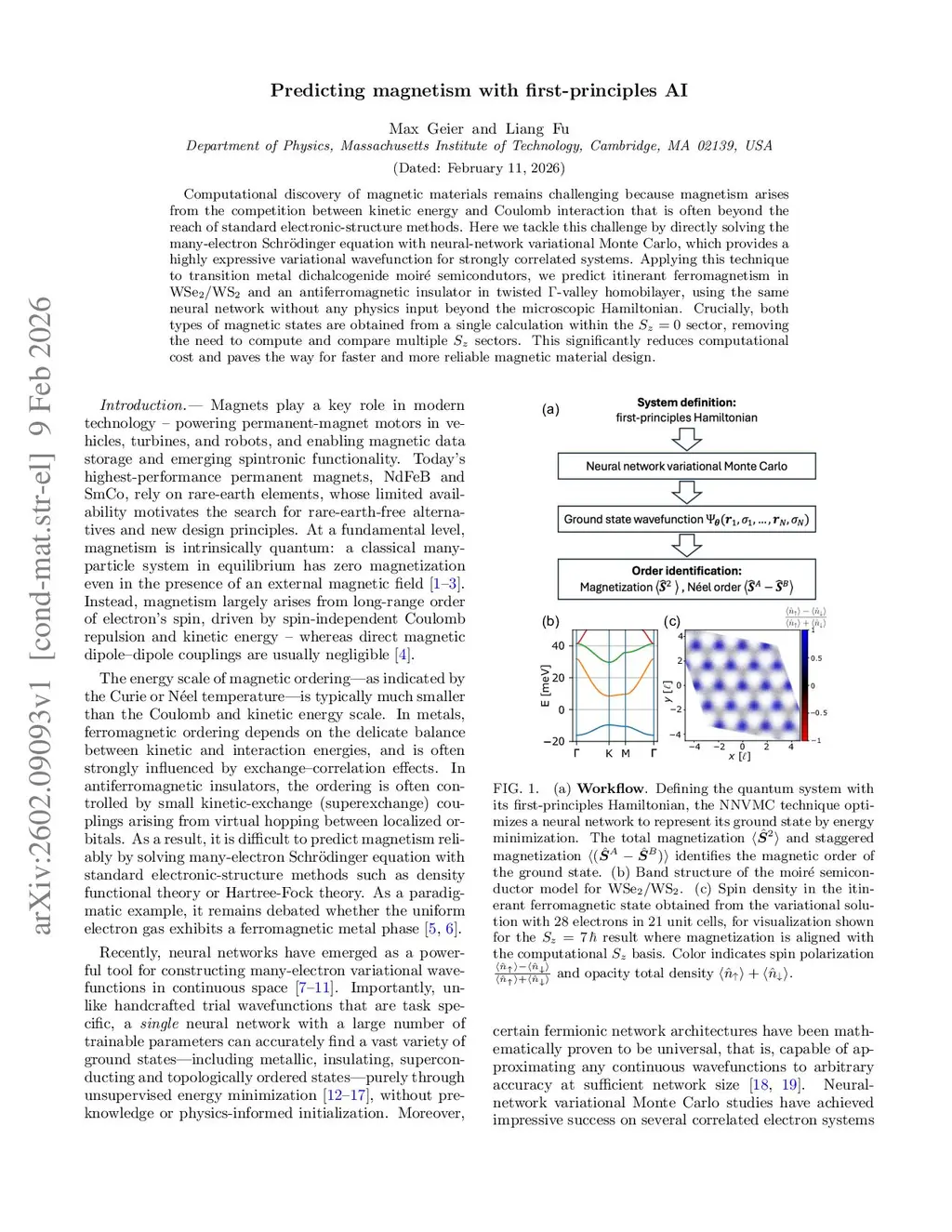
Computational discovery of magnetic materials remains challenging because magnetism arises from the competition between kinetic energy and Coulomb interaction that is often beyond the reach of standard electronic-structure methods. Here we tackle this challenge by directly solving the many-electron Schrödinger equation with neural-network variational Monte Carlo, which provides a highly expressive variational wavefunction for strongly correlated systems. Applying this technique to transition metal dichalcogenide moiré semicondutors, we predict itinerant ferromagnetism in WSe/WS and an antiferromagnetic insulator in twisted -valley homobilayer, using the same neural network without any physics input beyond the microscopic Hamiltonian. Crucially, both types of magnetic states are obtained from a single calculation within the sector, removing the need to compute and compare multiple sectors. This significantly reduces computational cost and paves the way for faster and more reliable magnetic material design.
View on arXiv