
Complex-Valued Unitary Representations as Classification Heads for Improved Uncertainty Quantification in Deep Neural Networks
- UQCV
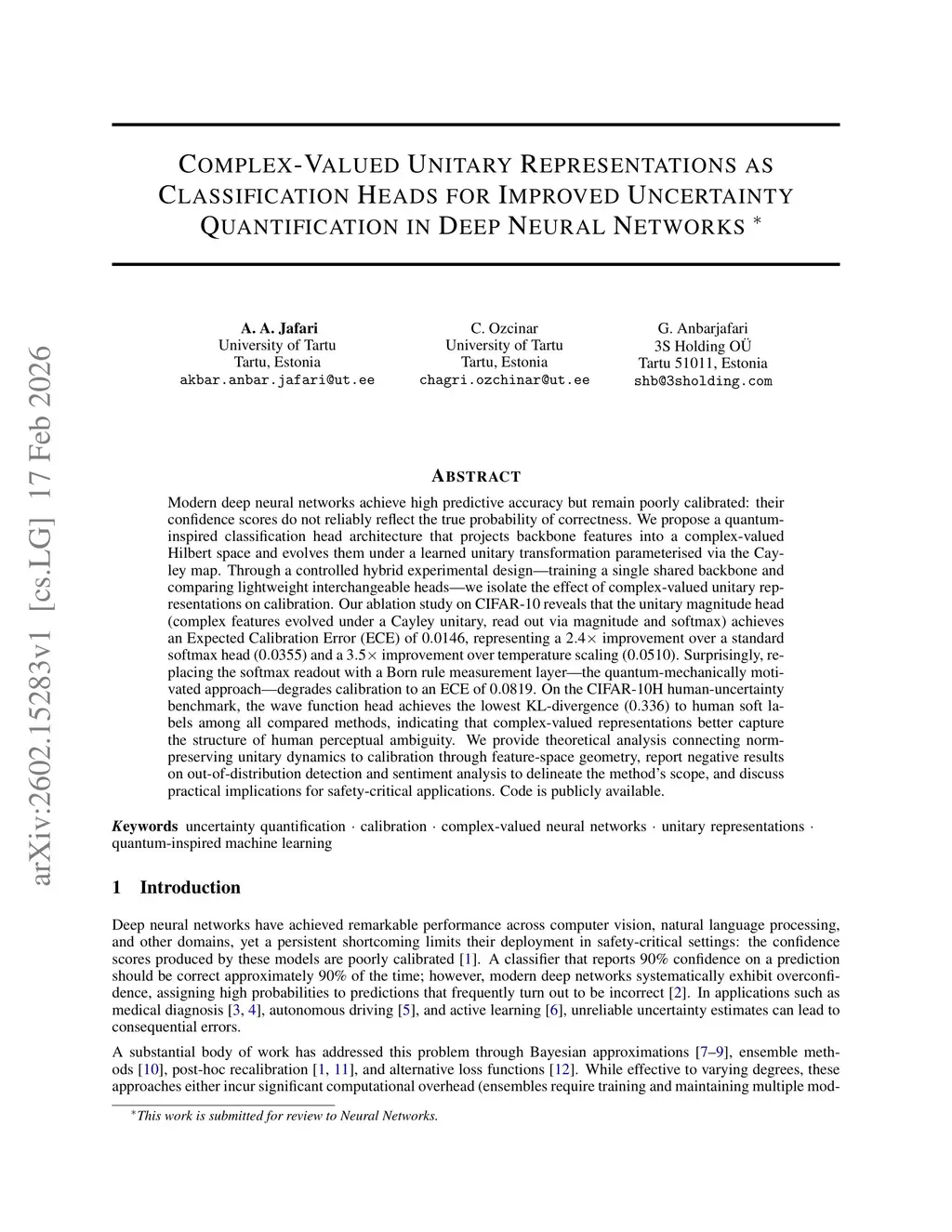
Modern deep neural networks achieve high predictive accuracy but remain poorly calibrated: their confidence scores do not reliably reflect the true probability of correctness. We propose a quantum-inspired classification head architecture that projects backbone features into a complex-valued Hilbert space and evolves them under a learned unitary transformation parameterised via the Cayley map. Through a controlled hybrid experimental design - training a single shared backbone and comparing lightweight interchangeable heads - we isolate the effect of complex-valued unitary representations on calibration. Our ablation study on CIFAR-10 reveals that the unitary magnitude head (complex features evolved under a Cayley unitary, read out via magnitude and softmax) achieves an Expected Calibration Error (ECE) of 0.0146, representing a 2.4x improvement over a standard softmax head (0.0355) and a 3.5x improvement over temperature scaling (0.0510). Surprisingly, replacing the softmax readout with a Born rule measurement layer - the quantum-mechanically motivated approach - degrades calibration to an ECE of 0.0819. On the CIFAR-10H human-uncertainty benchmark, the wave function head achieves the lowest KL-divergence (0.336) to human soft labels among all compared methods, indicating that complex-valued representations better capture the structure of human perceptual ambiguity. We provide theoretical analysis connecting norm-preserving unitary dynamics to calibration through feature-space geometry, report negative results on out-of-distribution detection and sentiment analysis to delineate the method's scope, and discuss practical implications for safety-critical applications. Code is publicly available.
View on arXiv