
Test-Time Adaptation for Tactile-Vision-Language Models
- TTAVLM
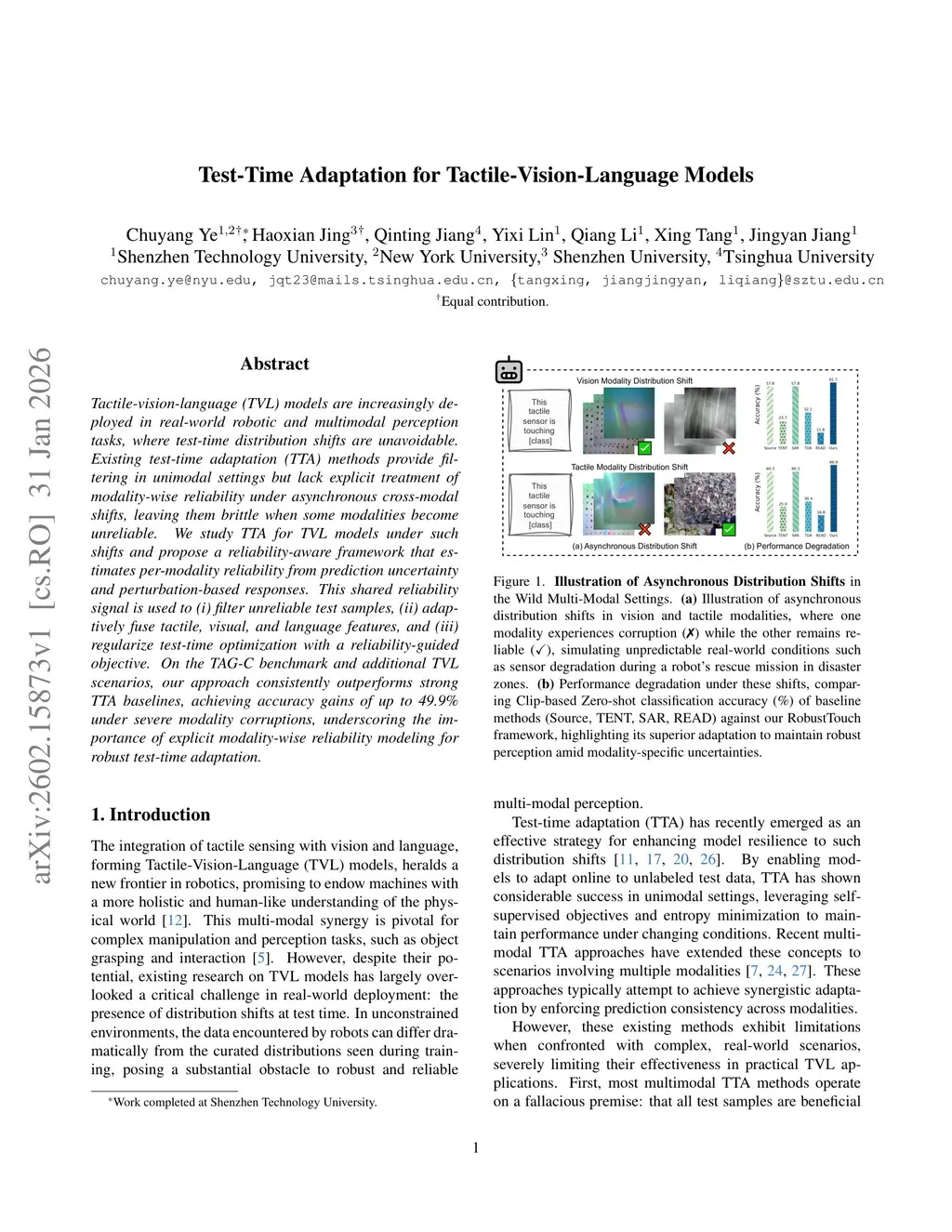
Tactile-vision-language (TVL) models are increasingly deployed in real-world robotic and multimodal perception tasks, where test-time distribution shifts are unavoidable. Existing test-time adaptation (TTA) methods provide filtering in unimodal settings but lack explicit treatment of modality-wise reliability under asynchronous cross-modal shifts, leaving them brittle when some modalities become unreliable. We study TTA for TVL models under such shifts and propose a reliability-aware framework that estimates per-modality reliability from prediction uncertainty and perturbation-based responses. This shared reliability signal is used to (i) filter unreliable test samples, (ii) adaptively fuse tactile, visual, and language features, and (iii) regularize test-time optimization with a reliability-guided objective. On the TAG-C benchmark and additional TVL scenarios, our approach consistently outperforms strong TTA baselines, achieving accuracy gains of up to 49.9\% under severe modality corruptions, underscoring the importance of explicit modality-wise reliability modeling for robust test-time adaptation.
View on arXiv