
DUET-VLM: Dual stage Unified Efficient Token reduction for VLM Training and Inference
- VLM
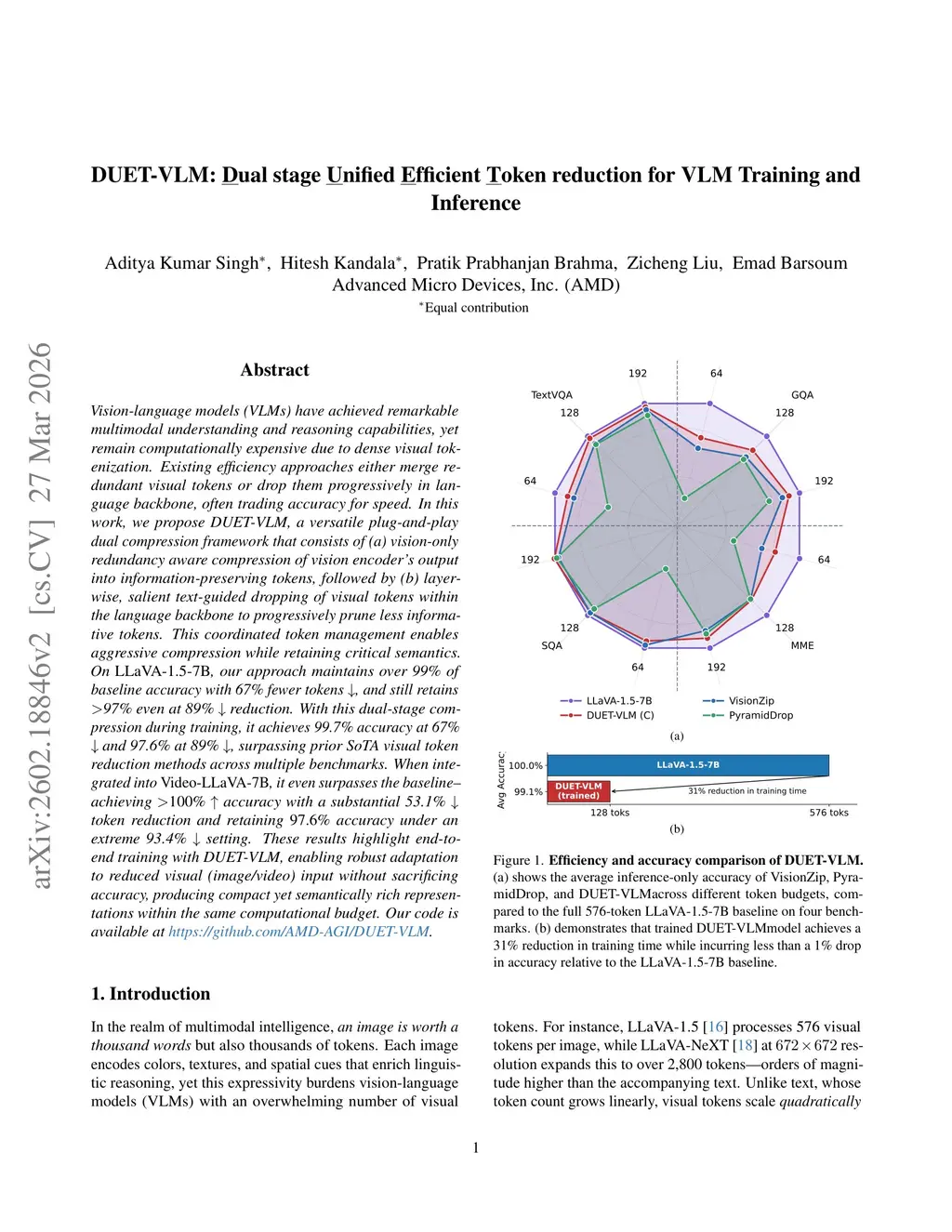
Vision-language models (VLMs) have achieved remarkable multimodal understanding and reasoning capabilities, yet remain computationally expensive due to dense visual tokenization. Existing efficiency approaches either merge redundant visual tokens or drop them progressively in language backbone, often trading accuracy for speed. In this work, we propose DUET-VLM, a versatile plug-and-play dual compression framework that consists of (a) vision-only redundancy aware compression of vision encoder's output into information-preserving tokens, followed by (b) layer-wise, salient text-guided dropping of visual tokens within the language backbone to progressively prune less informative tokens. This coordinated token management enables aggressive compression while retaining critical semantics. On LLaVA-1.5-7B, our approach maintains over 99% of baseline accuracy with 67% fewer tokens, and still retains >97% even at 89% reduction. With this dual-stage compression during training, it achieves 99.7% accuracy at 67% and 97.6% at 89%, surpassing prior SoTA visual token reduction methods across multiple benchmarks. When integrated into Video-LLaVA-7B, it even surpasses the baseline -- achieving >100% accuracy with a substantial 53.1% token reduction and retaining 97.6% accuracy under an extreme 93.4% setting. These results highlight end-to-end training with DUET-VLM, enabling robust adaptation to reduced visual (image/video) input without sacrificing accuracy, producing compact yet semantically rich representations within the same computational budget. Our code is available atthis https URL.
View on arXiv