
Robust Human Trajectory Prediction via Self-Supervised Skeleton Representation Learning
- 3DH
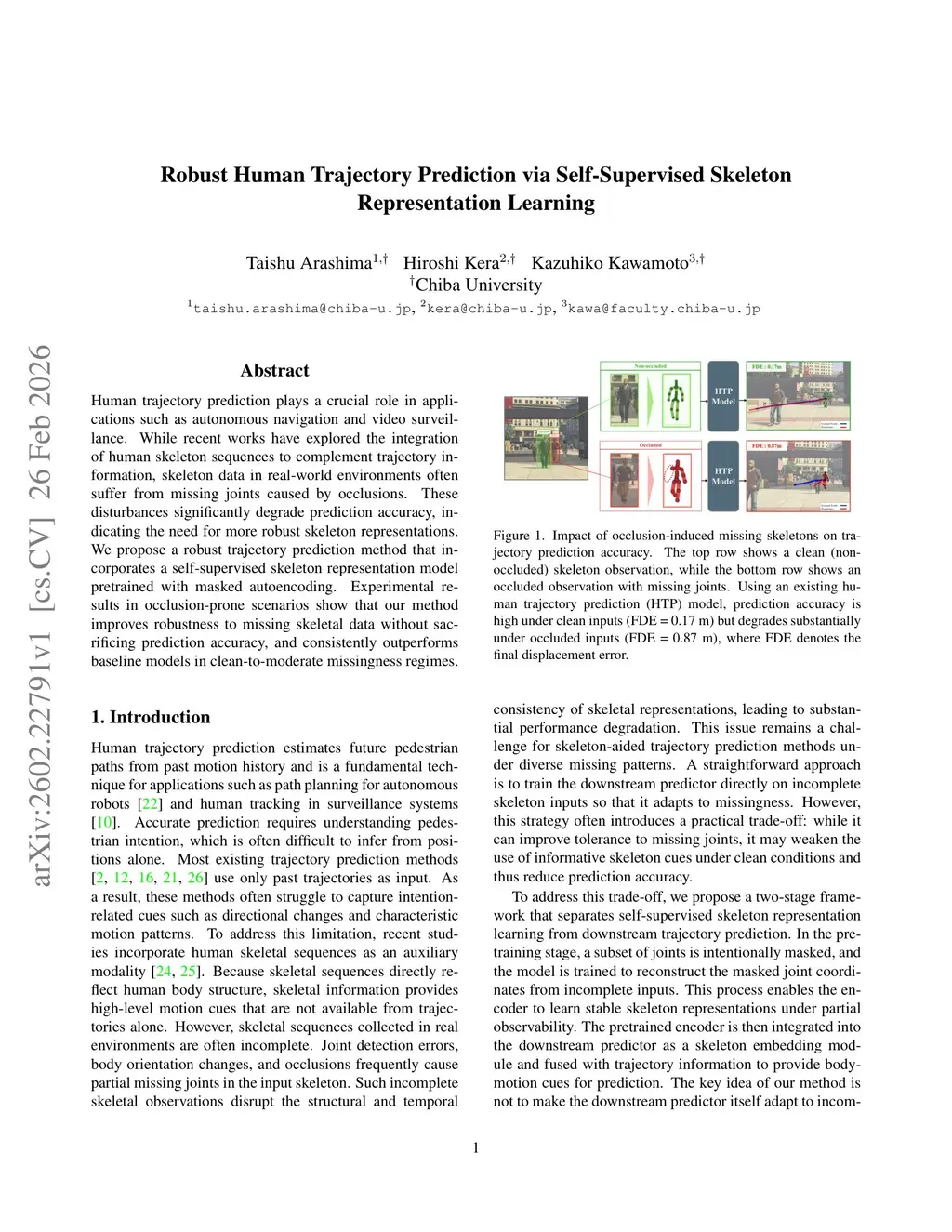
Human trajectory prediction plays a crucial role in applications such as autonomous navigation and video surveillance. While recent works have explored the integration of human skeleton sequences to complement trajectory information, skeleton data in real-world environments often suffer from missing joints caused by occlusions. These disturbances significantly degrade prediction accuracy, indicating the need for more robust skeleton representations. We propose a robust trajectory prediction method that incorporates a self-supervised skeleton representation model pretrained with masked autoencoding. Experimental results in occlusion-prone scenarios show that our method improves robustness to missing skeletal data without sacrificing prediction accuracy, and consistently outperforms baseline models in clean-to-moderate missingness regimes.
View on arXiv