
Annotation-Free Visual Reasoning for High-Resolution Large Multimodal Models via Reinforcement Learning
- OffRLVLMLRM
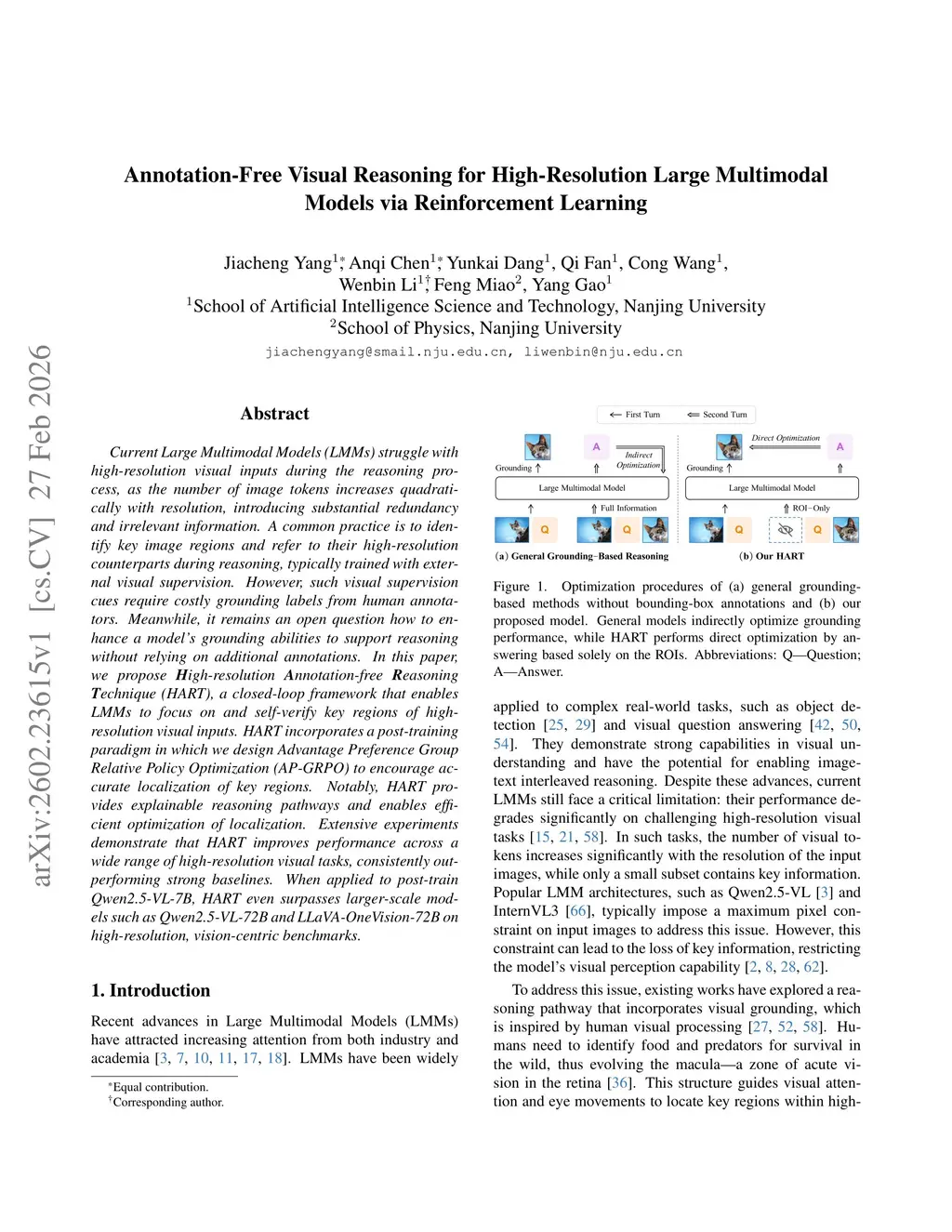
Current Large Multimodal Models (LMMs) struggle with high-resolution visual inputs during the reasoning process, as the number of image tokens increases quadratically with resolution, introducing substantial redundancy and irrelevant information. A common practice is to identify key image regions and refer to their high-resolution counterparts during reasoning, typically trained with external visual supervision. However, such visual supervision cues require costly grounding labels from human annotators. Meanwhile, it remains an open question how to enhance a model's grounding abilities to support reasoning without relying on additional annotations. In this paper, we propose High-resolution Annotation-free Reasoning Technique (HART), a closed-loop framework that enables LMMs to focus on and self-verify key regions of high-resolution visual inputs. HART incorporates a post-training paradigm in which we design Advantage Preference Group Relative Policy Optimization (AP-GRPO) to encourage accurate localization of key regions. Notably, HART provides explainable reasoning pathways and enables efficient optimization of localization. Extensive experiments demonstrate that HART improves performance across a wide range of high-resolution visual tasks, consistently outperforming strong baselines. When applied to post-train Qwen2.5-VL-7B, HART even surpasses larger-scale models such as Qwen2.5-VL-72B and LLaVA-OneVision-72B on high-resolution, vision-centric benchmarks.
View on arXiv