
DreamWorld: Unified World Modeling in Video Generation
- VGen
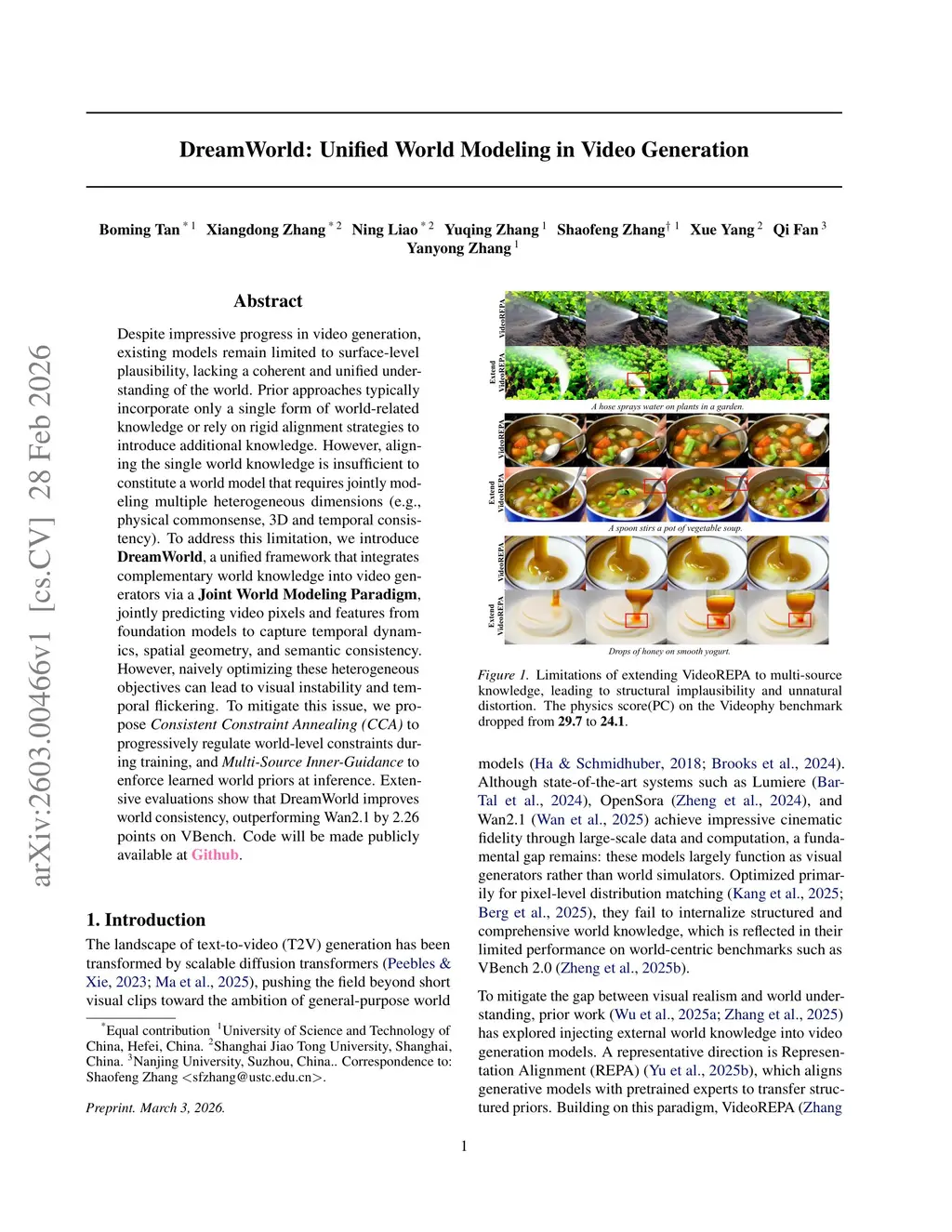
Despite impressive progress in video generation, existing models remain limited to surface-level plausibility, lacking a coherent and unified understanding of the world. Prior approaches typically incorporate only a single form of world-related knowledge or rely on rigid alignment strategies to introduce additional knowledge. However, aligning the single world knowledge is insufficient to constitute a world model that requires jointly modeling multiple heterogeneous dimensions (e.g., physical commonsense, 3D and temporal consistency). To address this limitation, we introduce \textbf{DreamWorld}, a unified framework that integrates complementary world knowledge into video generators via a \textbf{Joint World Modeling Paradigm}, jointly predicting video pixels and features from foundation models to capture temporal dynamics, spatial geometry, and semantic consistency. However, naively optimizing these heterogeneous objectives can lead to visual instability and temporal flickering. To mitigate this issue, we propose \textit{Consistent Constraint Annealing (CCA)} to progressively regulate world-level constraints during training, and \textit{Multi-Source Inner-Guidance} to enforce learned world priors at inference. Extensive evaluations show that DreamWorld improves world consistency, outperforming Wan2.1 by 2.26 points on VBench. Code will be made publicly available at \href{this https URL}{\textcolor{mypink}{\textbf{Github}}}.
View on arXiv