
DeAR: Fine-Grained VLM Adaptation by Decomposing Attention Head Roles
- VLM
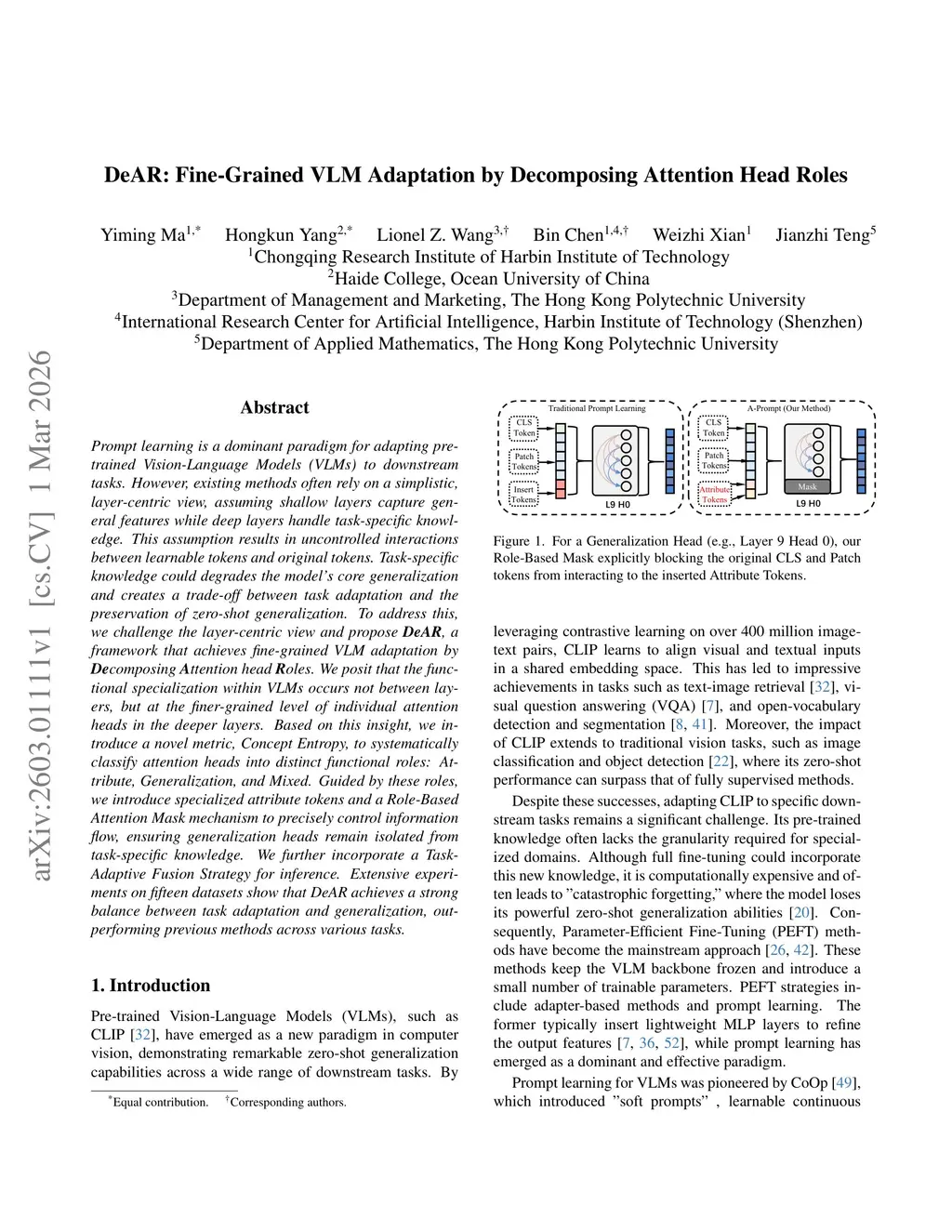
Prompt learning is a dominant paradigm for adapting pre-trained Vision-Language Models (VLMs) to downstream tasks. However, existing methods often rely on a simplistic, layer-centric view, assuming shallow layers capture general features while deep layers handle task-specific knowledge. This assumption results in uncontrolled interactions between learnable tokens and original tokens. Task-specific knowledge could degrades the model's core generalization and creates a trade-off between task adaptation and the preservation of zero-shot generalization. To address this, we challenge the layer-centric view and propose \textbf{DeAR}, a framework that achieves fine-grained VLM adaptation by \textbf{De}composing \textbf{A}ttention head \textbf{R}oles. We posit that the functional specialization within VLMs occurs not between layers, but at the finer-grained level of individual attention heads in the deeper layers. Based on this insight, we introduce a novel metric, Concept Entropy, to systematically classify attention heads into distinct functional roles: \textit{Attribute}, \textit{Generalization}, and \textit{Mixed}. Guided by these roles, we introduce specialized attribute tokens and a Role-Based Attention Mask mechanism to precisely control information flow, ensuring generalization heads remain isolated from task-specific knowledge. We further incorporate a Task-Adaptive Fusion Strategy for inference. Extensive experiments on fifteen datasets show that DeAR achieves a strong balance between task adaptation and generalization, outperforming previous methods across various tasks.
View on arXiv