
On the Vulnerability of FHE Computation to Silent Data Corruption
- FedML
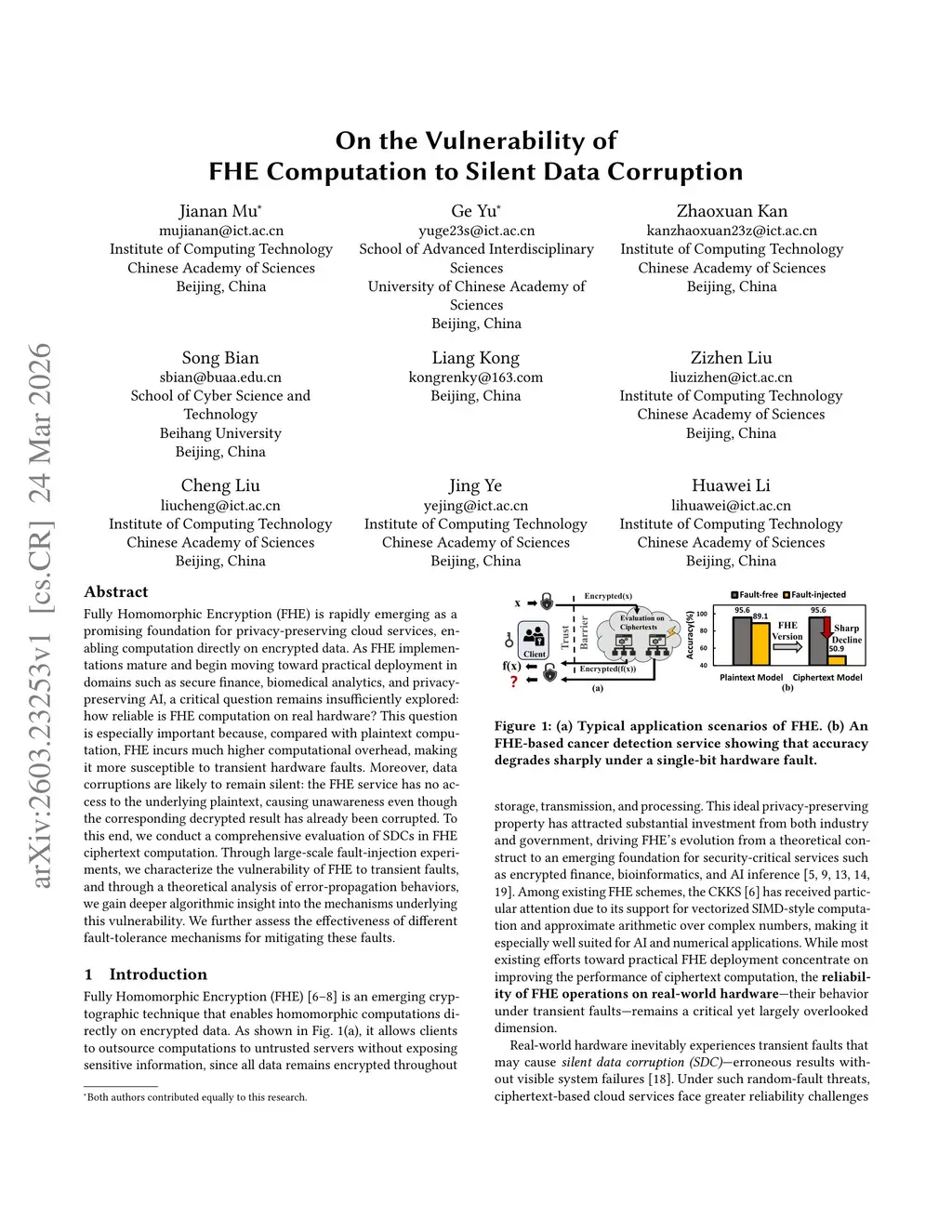
Fully Homomorphic Encryption (FHE) is rapidly emerging as a promising foundation for privacy-preserving cloud services, enabling computation directly on encrypted data. As FHE implementations mature and begin moving toward practical deployment in domains such as secure finance, biomedical analytics, and privacy-preserving AI, a critical question remains insufficiently explored: how reliable is FHE computation on real hardware? This question is especially important because, compared with plaintext computation, FHE incurs much higher computational overhead, making it more susceptible to transient hardware faults. Moreover, data corruptions are likely to remain silent: the FHE service has no access to the underlying plaintext, causing unawareness even though the corresponding decrypted result has already been corrupted. To this end, we conduct a comprehensive evaluation of SDCs in FHE ciphertext computation. Through large-scale fault-injection experiments, we characterize the vulnerability of FHE to transient faults, and through a theoretical analysis of error-propagation behaviors, we gain deeper algorithmic insight into the mechanisms underlying this vulnerability. We further assess the effectiveness of different fault-tolerance mechanisms for mitigating these faults.
View on arXiv