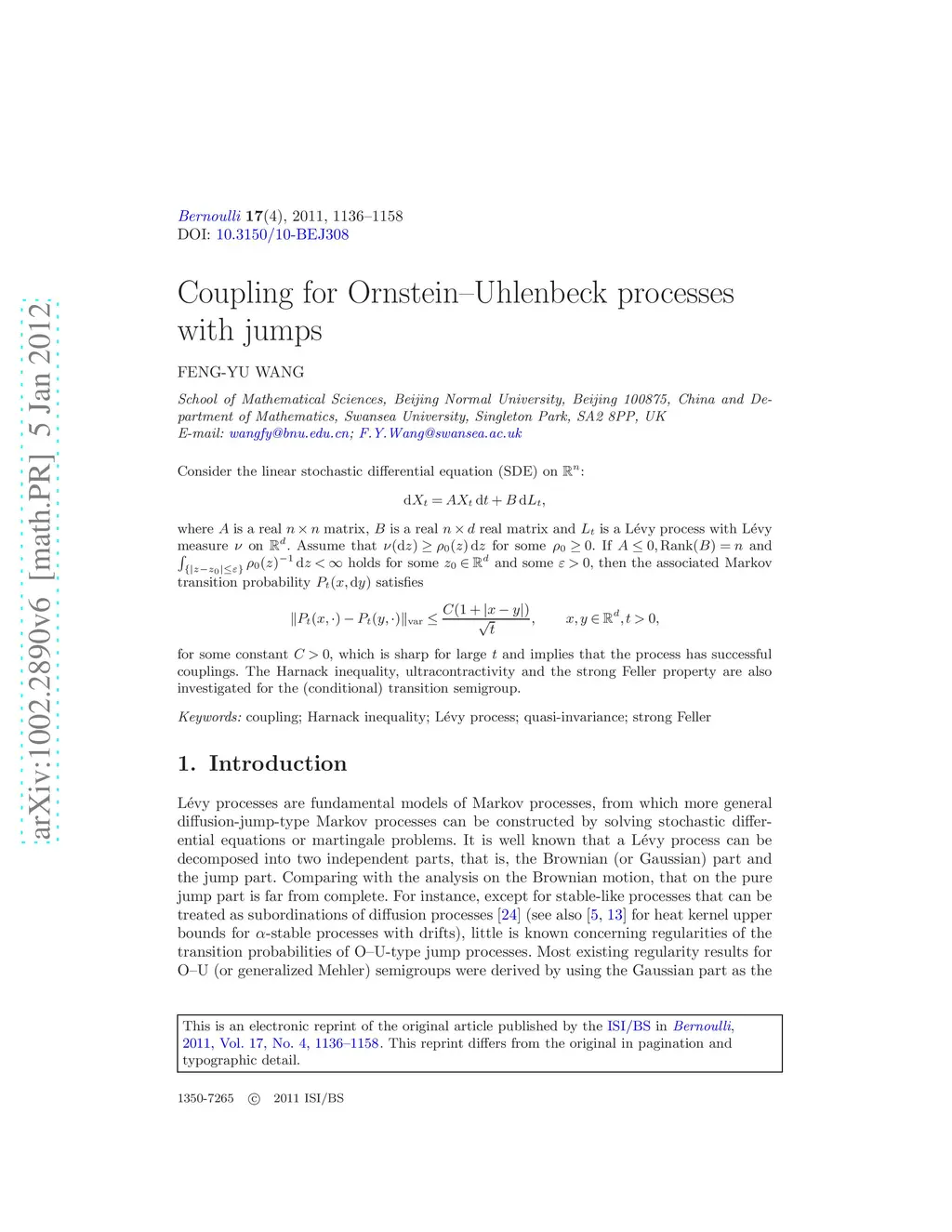
Consider the linear SDE on Rn:
\dXt=AXt\dt+B\dLt, where A is a real n×n matrix, B
is a real n×d real matrix and Lt is a L\'evy process with L\'evy
measure ν on Rd. Assume that
ν(\dz)≥\rr0(z)\dz for some \rr0≥0. If A≤0,\Rank(B)=n
and ∫{∣z−z0∣≤\vv}\rr0(z)−1\dz<∞ holds for some z0∈Rd and some \vv>0, then the associated Markov transition probability
Pt(x,\dy) satisfies ∥Pt(x,⋅)−Pt(y,⋅)∥var≤\ffC(1+∣x−y∣)\sst,x,y∈Rd,t>0 for some constant C>0, which is
sharp for large t and implies that the process has successful couplings.
Harnack inequality, ultracontractivity and strong Feller property are also
investigated for the transition semigroup.