
Universality for the largest eigenvalue of sample covariance matrices
with general population
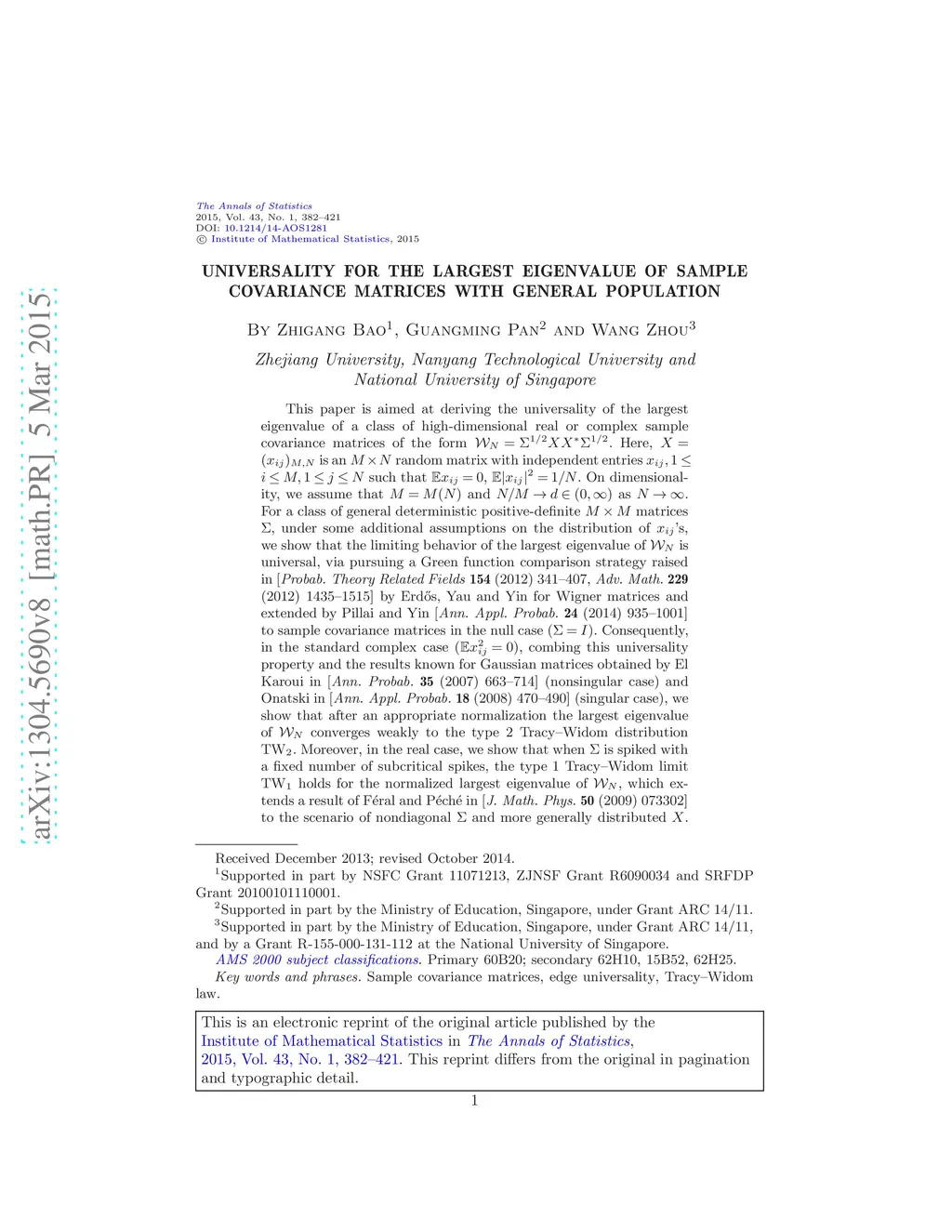
This paper is aimed at deriving the universality of the largest eigenvalue of a class of high-dimensional real or complex sample covariance matrices of the form . Here, is an random matrix with independent entries such that , . On dimensionality, we assume that and as . For a class of general deterministic positive-definite matrices , under some additional assumptions on the distribution of 's, we show that the limiting behavior of the largest eigenvalue of is universal, via pursuing a Green function comparison strategy raised in [Probab. Theory Related Fields 154 (2012) 341-407, Adv. Math. 229 (2012) 1435-1515] by Erd\H{o}s, Yau and Yin for Wigner matrices and extended by Pillai and Yin [Ann. Appl. Probab. 24 (2014) 935-1001] to sample covariance matrices in the null case (). Consequently, in the standard complex case (), combing this universality property and the results known for Gaussian matrices obtained by El Karoui in [Ann. Probab. 35 (2007) 663-714] (nonsingular case) and Onatski in [Ann. Appl. Probab. 18 (2008) 470-490] (singular case), we show that after an appropriate normalization the largest eigenvalue of converges weakly to the type 2 Tracy-Widom distribution . Moreover, in the real case, we show that when is spiked with a fixed number of subcritical spikes, the type 1 Tracy-Widom limit holds for the normalized largest eigenvalue of , which extends a result of F\'{e}ral and P\'{e}ch\'{e} in [J. Math. Phys. 50 (2009) 073302] to the scenario of nondiagonal and more generally distributed .
View on arXiv