Communities
Connect sessions
AI calendar
Organizations
Join Slack
Contact Sales
Search
Open menu
Home
Papers
1602.00177
Cited By
Tracing liquid level and material boundaries in transparent vessels using the graph cut computer vision approach
31 January 2016
S. Eppel
Re-assign community
ArXiv (abs)
PDF
HTML
Papers citing
"Tracing liquid level and material boundaries in transparent vessels using the graph cut computer vision approach"
6 / 6 papers shown
Vision-based robot manipulation of transparent liquid containers in a laboratory setting
Daniel Schober
Ronja Güldenring
James Love
Lazaros Nalpantidis
131
5
0
25 Apr 2024
Predicting 3D shapes, masks, and properties of materials, liquids, and objects inside transparent containers, using the TransProteus CGI dataset
S. Eppel
Haoping Xu
Yi Ru Wang
Alán Aspuru-Guzik
3DV
DiffM
239
4
0
15 Sep 2021
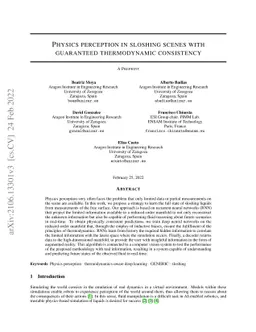
Physics perception in sloshing scenes with guaranteed thermodynamic consistency
B. Moya
Alberto Badías
D. González
Francisco Chinesta
Elías Cueto
330
17
0
24 Jun 2021
Manifold Denoising by Nonlinear Robust Principal Component Analysis
Neural Information Processing Systems (NeurIPS), 2019
He Lyu
Ningyu Sha
Shuyang Qin
Ming Yan
Yuying Xie
Rongrong Wang
90
15
0
10 Nov 2019
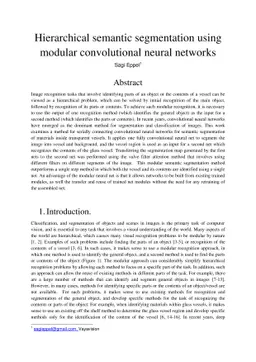
Hierarchical semantic segmentation using modular convolutional neural networks
S. Eppel
224
9
0
14 Oct 2017
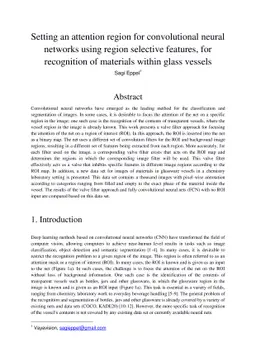
Setting an attention region for convolutional neural networks using region selective features, for recognition of materials within glass vessels
S. Eppel
197
25
0
29 Aug 2017
1
Page 1 of 1