
Dynamic Occupancy Grid Prediction for Urban Autonomous Driving: A Deep
Learning Approach with Fully Automatic Labeling
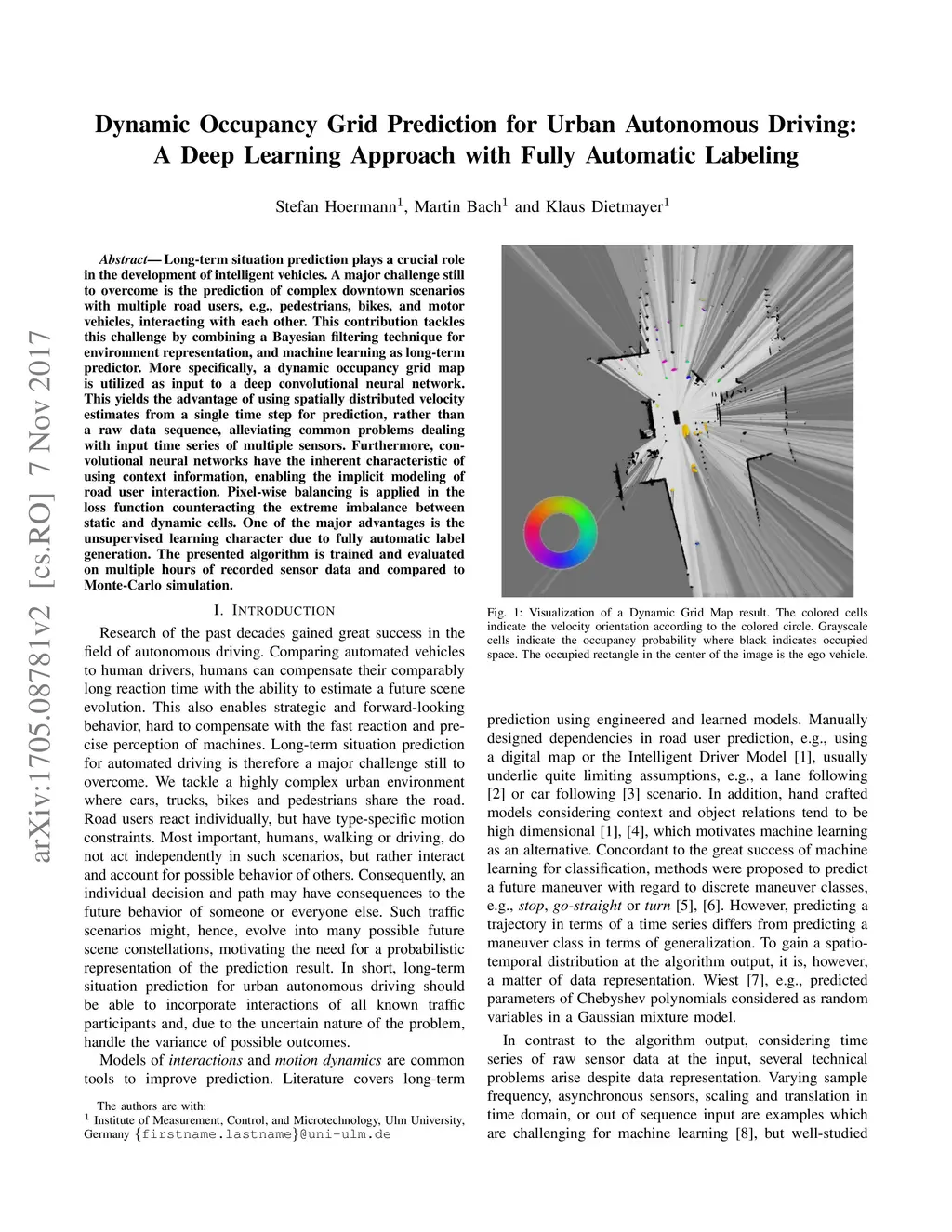
Long-term situation prediction plays a crucial role in the development of intelligent vehicles. A major challenge still to overcome is the prediction of complex downtown scenarios with mutiple road users interacting with each other. This contribution tackles this challenge by combining a Bayesian filtering technique for environment representation and machine learning as long-term predictor. Therefore, a dynamic occupancy grid map representing the static and dynamic environment around the ego-vehicle is utilized as input to a deep convolutional neural network. This yields the advantage of using data from a single timestamp for prediction, rather than an entire time series, alleviating common problems dealing with input time series. Furthermore, convolutional neural networks have the inherent characteristic of using context information, enabling the implicit modeling of road user interaction. Considering the extremely unbalanced data of dynamic and static grid cells, a pixel-wise balancing loss function for the training of the neural network is introduced. One of the major advantages is the unsupervised learning character due to fully automatic label generation. The presented algorithm is trained and evaluated on multiple hours of recorded sensor data. The recorded scenario is comprised of a shared space containing multiple road users, e.g., pedestrians, bikes and vehicles.
View on arXiv