
Top-Related Meta-Learning Method for Few-Shot Detection
- ObjDVLM
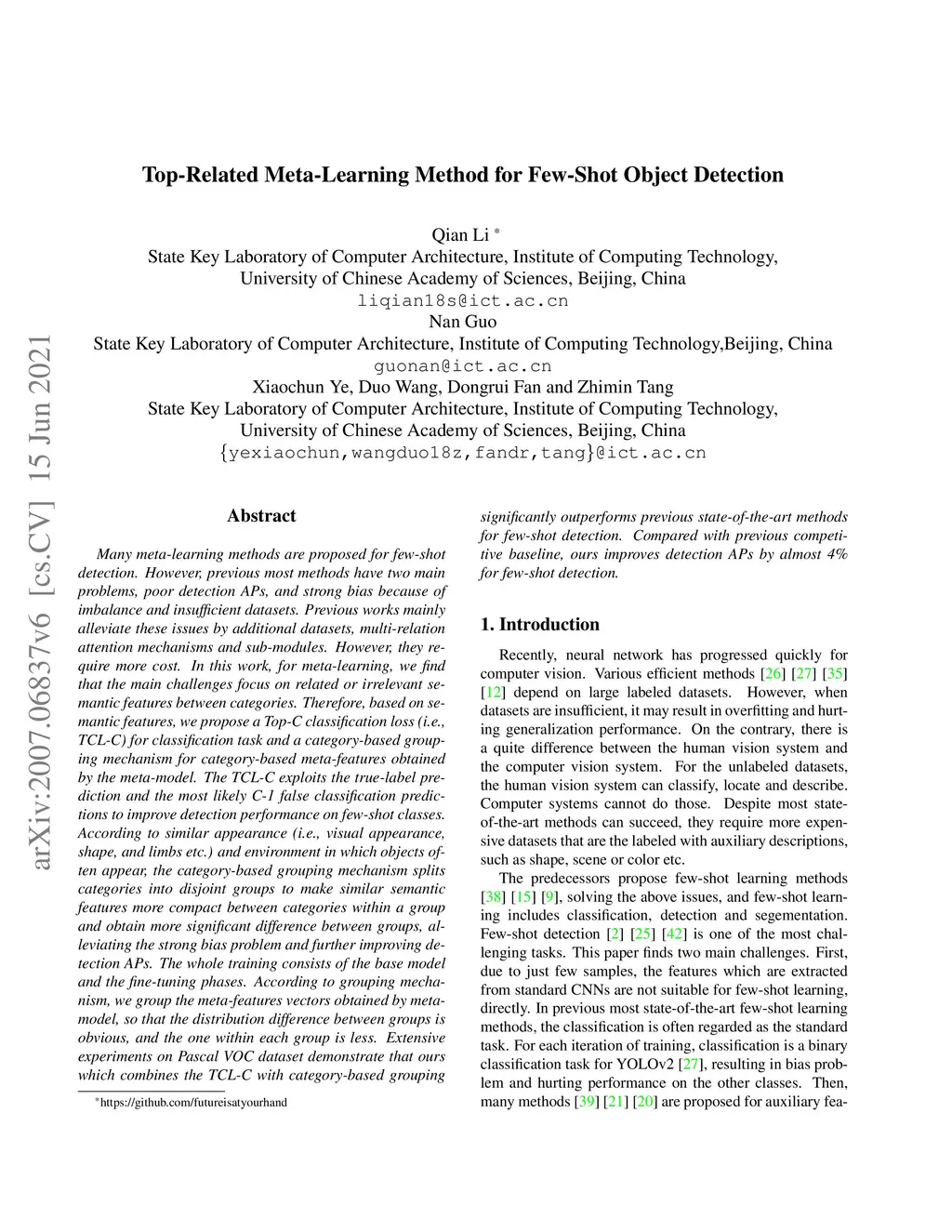
Many meta-learning methods are proposed for few-shot detection. However, previous most methods have two main problems, poor detection APs, and strong bias because of imbalance datasets. Previous works mainly alleviate these issues by additional datasets, multi-relation attention mechanisms and sub-modules. However, they require more cost. In this work, for meta-learning, we find that the main challenges focus on related or irrelevant semantic features between different categories, and poor distribution of category-based meta-features. Therefore, we propose a Top-C classification loss (i.e. TCL-C) for classification task and a category-based grouping mechanism. The TCL exploits true-label and the most similar class to improve detection performance on few-shot classes. According to appearance and environment, the category-based grouping mechanism groups categories into different groupings to make similar semantic features more compact for different categories, alleviating the strong bias problem and further improving detection APs. The whole training consists of the base model and the fine-tuning phase. During training detection model, the category-related meta-features are regarded as the weights to convolve dynamically, exploiting the meta-features with a shared distribution between categories within a group to improve the detection performance. According to grouping mechanism, we group the meta-features vectors, so that the distribution difference between groups is obvious, and the one within each group is less. Extensive experiments on Pascal VOC dataset demonstrate that ours which combines the TCL with category-based grouping significantly outperforms previous state-of-the-art methods for few-shot detection. Compared with previous competitive baseline, ours improves detection AP by almost 4% for few-shot detection.
View on arXiv