
Skeleton Based Isolated Sign Language Recognition Using Whole-body
Keypoints in a Universal Multi-modal Framework
- SLR
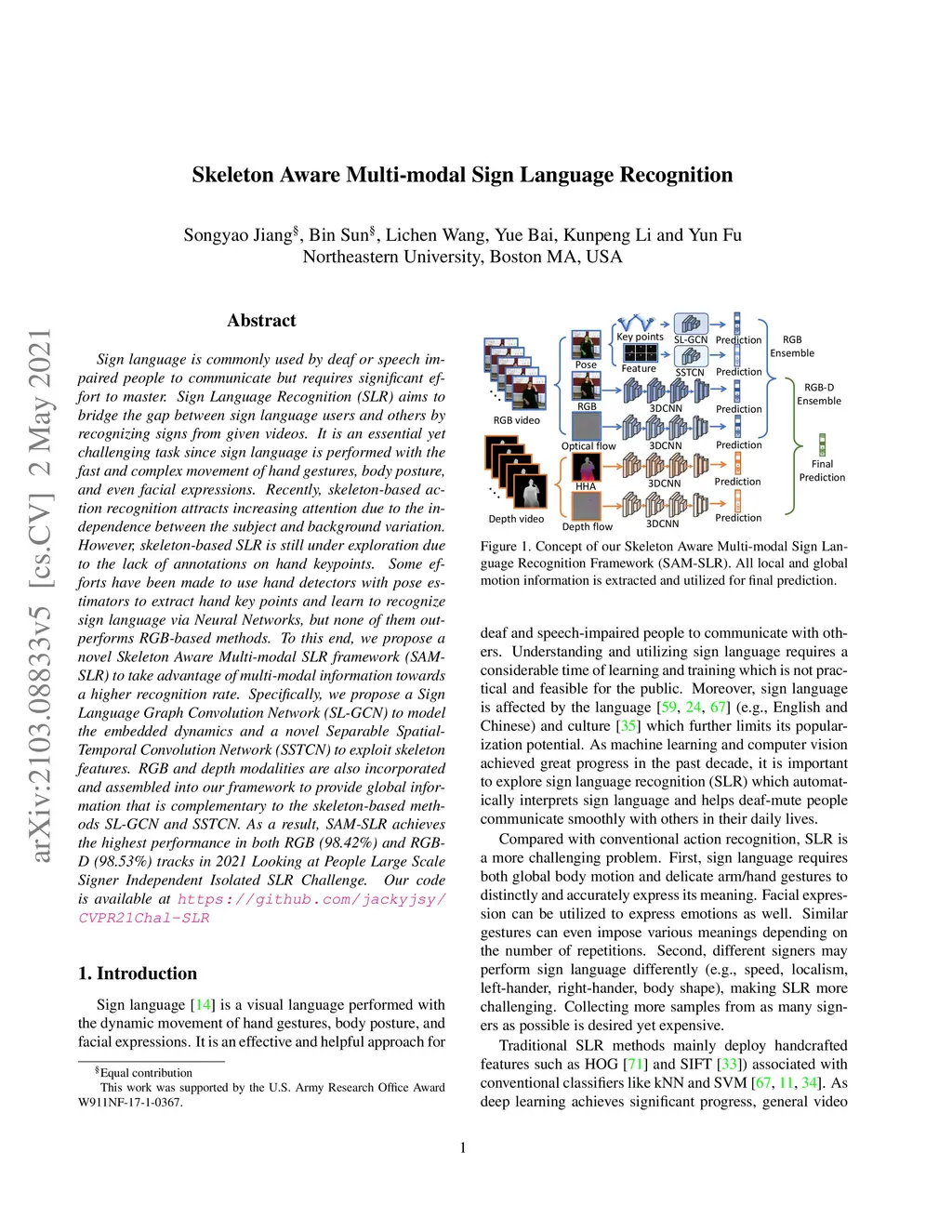
Sign language is used by deaf or speech impaired people to communicate, and requires great efforts to master. Sign Language Recognition (SLR) aims to make a bridge between sign language users and the others by recognize the word from given videos. It is a important yet challenging task since sign language is performed with fast and complex movement of hand gestures, body posture and even facial expressions. Recently, skeleton based action recognition attracts increasing attention due to the independence on subjects and background variations. It is also a strong complement to RGB/D modalities to further boost the overall recognition rate. However, skeleton based on SLR is still under exploration due to the lack of annotations on hand keypoints. Some efforts have been made to use hand detectors with pose estimator to extract hand keypoints, and learn to recognize sign language via a Recurrent Neural Network, but none of them outperforms RGB based methods. To this end, we propose a novel skeleton based SLR approach using whole-body keypoints with a universal multi-modal SLR framework (Uni-SLR) to further improve the recognition rate. Specifically, we propose a Graph Convolution Network (GCN) to model the embedded spatial relations and dynamic motions, and propose a novel Separable Spatial-Temporal Convolution Network (SSTCN) to exploit skeleton features. Our skeleton based method achieves a higher recognition rate compared with all other single modalities. Moreover, our proposed Uni-SLR framework can further enhance the performance by assembling our skeleton based method with other RGB and depth modalities. As a result, our Uni-SLR framework achieves the highest performance in both RGB (98.42\%) and RGB-D (98.53\%) tracks in 2021 Looking at People Large Scale Signer Independent Isolated SLR Challenge. Our code will be provided in \url{https://github.com/jackyjsy/CVPR21Chal-SLR}.
View on arXiv