
Escaping the Impossibility of Fairness: From Formal to Substantive
Algorithmic Fairness
- FaML
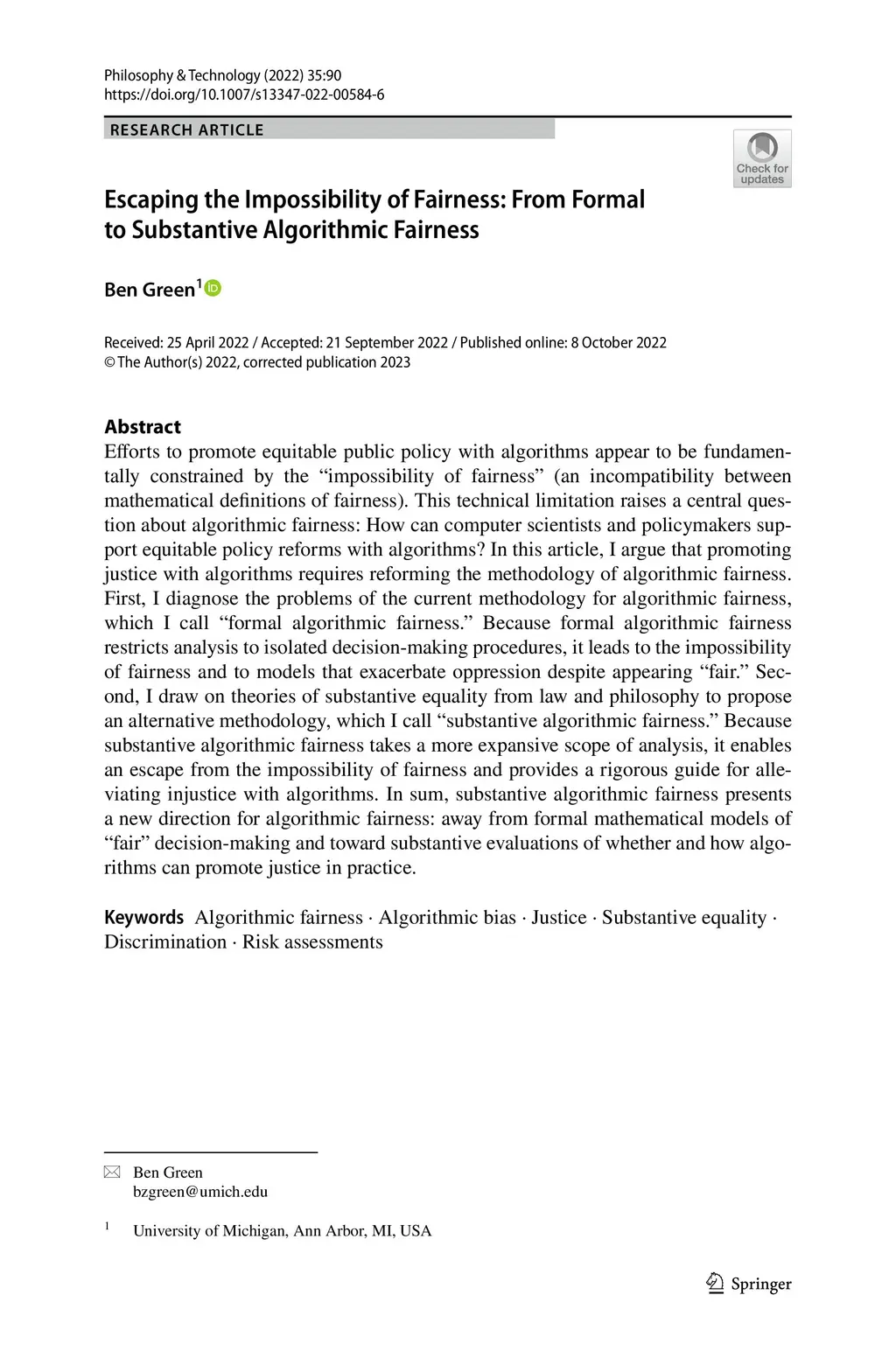
The burgeoning field of "algorithmic fairness" provides a novel set of methods for reasoning about the fairness of algorithmic predictions and decisions. Yet even as algorithmic fairness has become a prominent component of efforts to enhance equality in domains such public policy, it also faces significant limitations and critiques. The most fundamental issue is the mathematical result known as the "impossibility of fairness" (an incompatibility between mathematical definitions of fairness). Furthermore, many algorithms that satisfy standards of fairness actually exacerbate oppression. These two issues call into question whether algorithmic fairness can play a productive role in the pursuit of equality. In this paper, I diagnose these issues as the product of algorithmic fairness methodology and propose an alternative path forward for the field. The dominant approach of "formal algorithmic fairness" suffers from a fundamental limitation: it relies on a narrow frame of analysis that is limited to specific decision-making processes, in isolation from the context of those decisions. In light of this shortcoming, I draw on theories of substantive equality from law and philosophy to propose an alternative method: "substantive algorithmic fairness." Substantive algorithmic fairness takes a more expansive scope to analyzing fairness, looking beyond specific decision points to account for social hierarchies and the impacts of decisions facilitated by algorithms. As a result, substantive algorithmic fairness suggests reforms that combat oppression and that provide an escape from the impossibility of fairness. Moreover, substantive algorithmic fairness presents a new direction for the field of algorithmic fairness: away from formal mathematical models of "fairness" and towards substantive evaluations of how algorithms can (and cannot) promote equality.
View on arXiv