
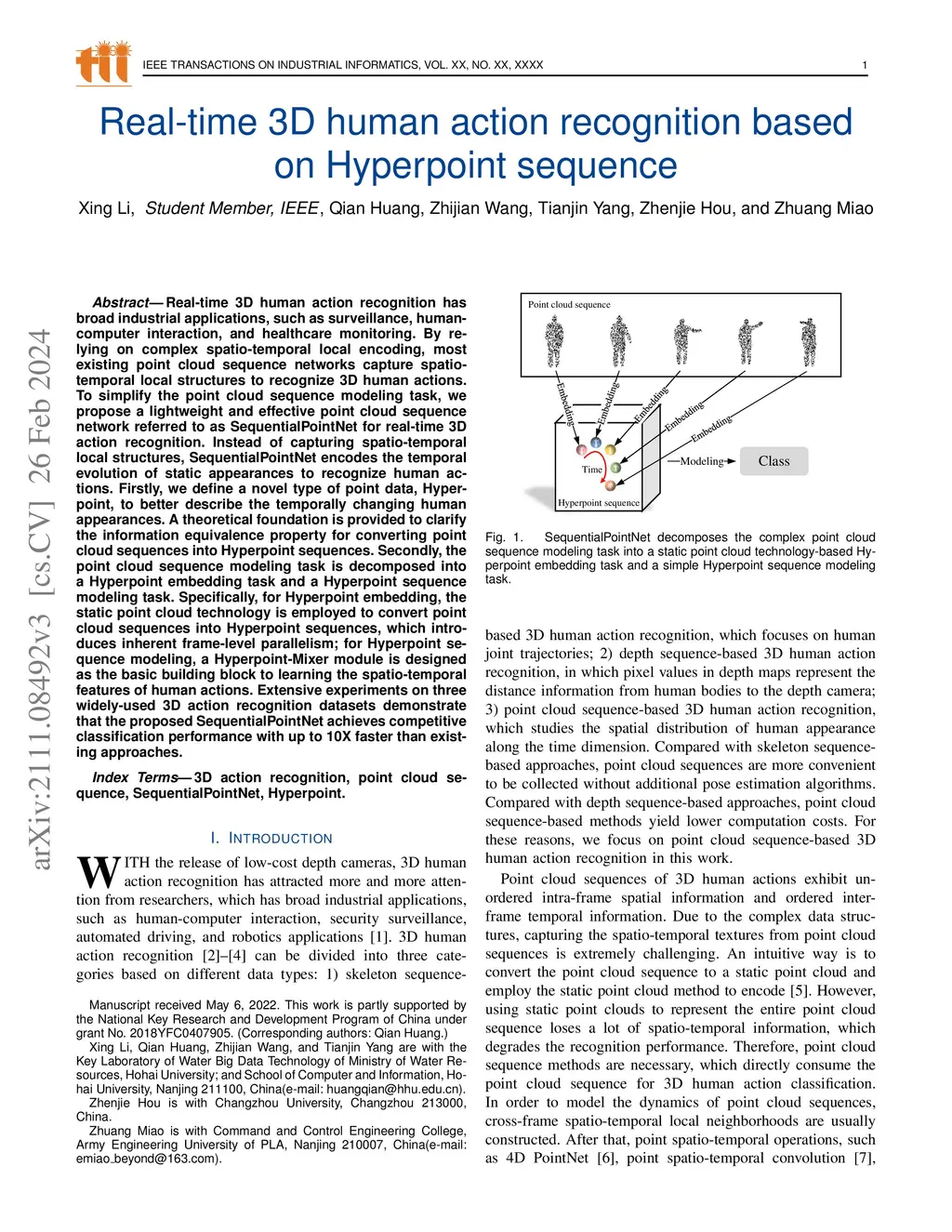
Point cloud sequences of 3D human actions exhibit unordered intra-frame spatial information and ordered interframe temporal information. In order to capture the spatiotemporal structures of the point cloud sequences, cross-frame spatio-temporal local neighborhoods around the centroids are usually constructed. However, the computationally expensive construction procedure of spatio-temporal local neighborhoods severely limits the parallelism of models. Moreover, it is unreasonable to treat spatial and temporal information equally in spatio-temporal local learning, because human actions are complicated along the spatial dimensions and simple along the temporal dimension. In this paper, to avoid spatio-temporal local encoding, we propose a strong parallelized point cloud sequence network referred to as SequentialPointNet for 3D action recognition. SequentialPointNet is composed of two serial modules, i.e., an intra-frame appearance encoding module and an inter-frame motion encoding module. For modeling the strong spatial structures of human actions, each point cloud frame is processed in parallel in the intra-frame appearance encoding module and the feature vector of each frame is output to form a feature vector sequence that characterizes static appearance changes along the temporal dimension. For modeling the weak temporal changes of human actions, in the inter-frame motion encoding module, the temporal position encoding and the hierarchical pyramid pooling strategy are implemented on the feature vector sequence. In addition, in order to better explore spatio-temporal content, multiple level features of human movements are aggregated before performing the end-to-end 3D action recognition. Extensive experiments conducted on three public datasets show that SequentialPointNet outperforms stateof-the-art approaches.
View on arXiv