
Optimal No-Regret Learning in Strongly Monotone Games with Bandit
Feedback
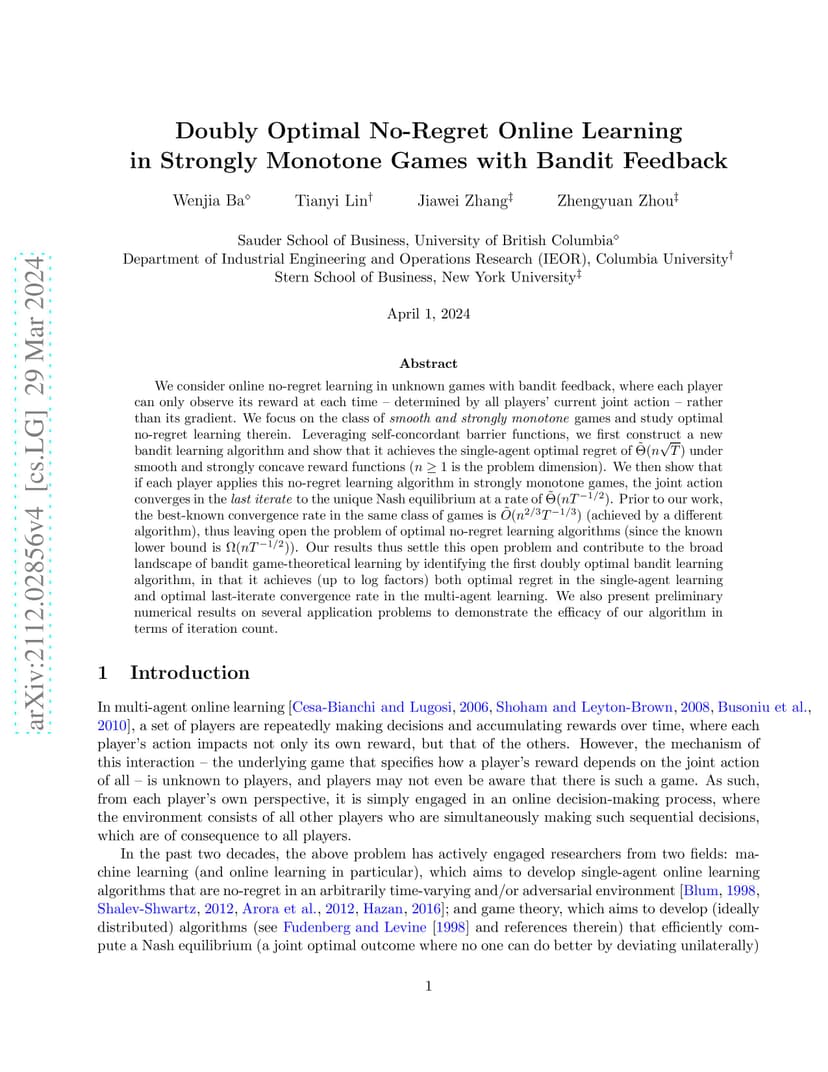
We consider online no-regret learning in unknown games with bandit feedback, where each agent only observes its reward at each time -- determined by all players' current joint action -- rather than its gradient. We focus on the class of smooth and strongly monotone games and study optimal no-regret learning therein. Leveraging self-concordant barrier functions, we first construct an online bandit convex optimization algorithm and show that it achieves the single-agent optimal regret of under smooth and strongly-concave payoff functions. We then show that if each agent applies this no-regret learning algorithm in strongly monotone games, the joint action converges in \textit{last iterate} to the unique Nash equilibrium at a rate of . Prior to our work, the best-know convergence rate in the same class of games is (achieved by a different algorithm), thus leaving open the problem of optimal no-regret learning algorithms (since the known lower bound is ). Our results thus settle this open problem and contribute to the broad landscape of bandit game-theoretical learning by identifying the first doubly optimal bandit learning algorithm, in that it achieves (up to log factors) both optimal regret in the single-agent learning and optimal last-iterate convergence rate in the multi-agent learning. We also present results on several simulation studies -- Cournot competition, Kelly auctions, and distributed regularized logistic regression -- to demonstrate the efficacy of our algorithm.
View on arXiv