
SparseDet: Improving Sparsely Annotated Object Detection with
Pseudo-positive Mining
- ObjD
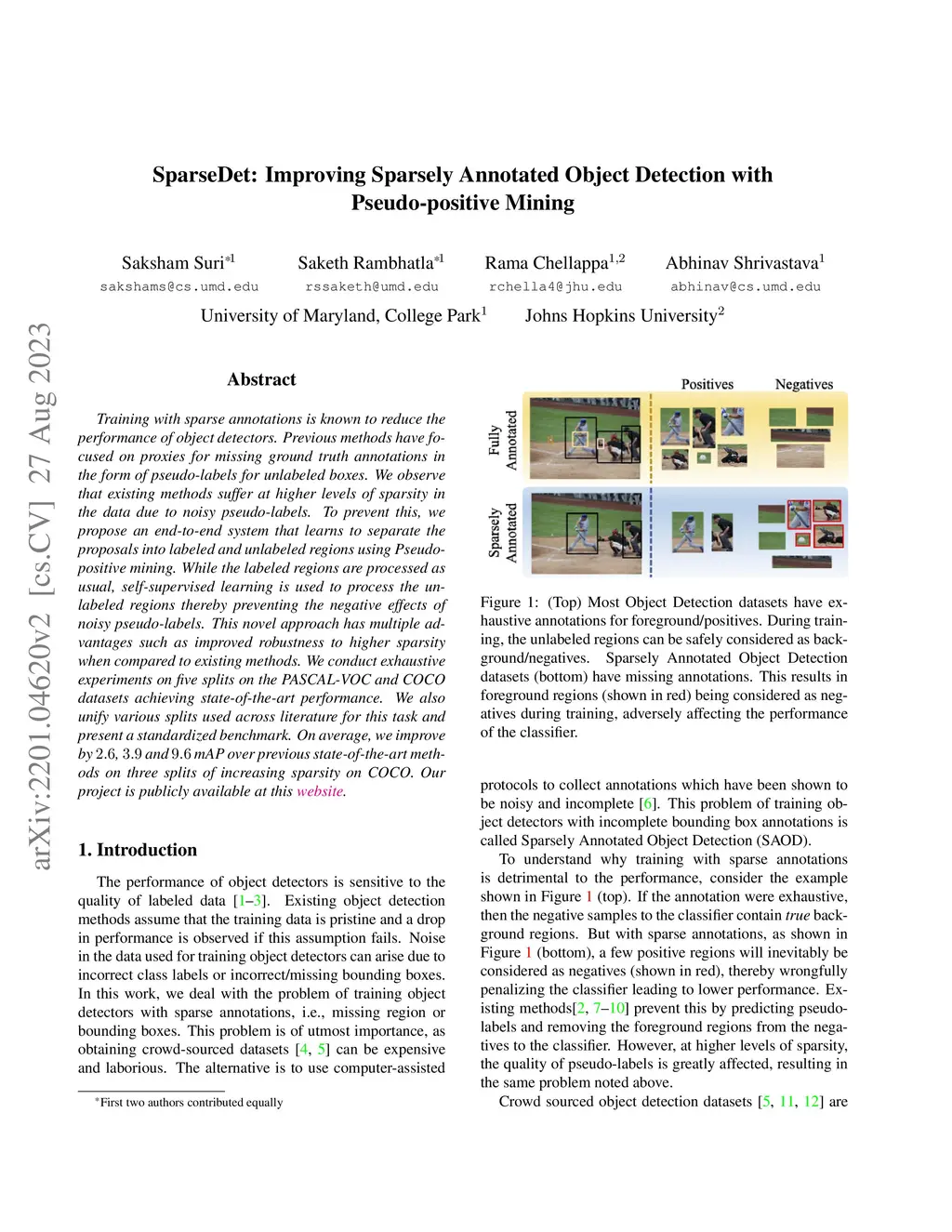
Training with sparse annotations is known to reduce the performance of object detectors. Previous methods have focused on proxies for missing ground truth annotations in the form of pseudo-labels for unlabeled boxes. We observe that existing methods suffer at higher levels of sparsity in the data due to noisy pseudo-labels. To prevent this, we propose an end-to-end system that learns to separate the proposals into labeled and unlabeled regions using Pseudo-positive mining. While the labeled regions are processed as usual, self-supervised learning is used to process the unlabeled regions thereby preventing the negative effects of noisy pseudo-labels. This novel approach has multiple advantages such as improved robustness to higher sparsity when compared to existing methods. We conduct exhaustive experiments on five splits on the PASCAL-VOC and COCO datasets achieving state-of-the-art performance. We also unify various splits used across literature for this task and present a standardized benchmark. On average, we improve by , and mAP over previous state-of-the-art methods on three splits of increasing sparsity on COCO. Our project is publicly available at https://www.cs.umd.edu/~sakshams/SparseDet.
View on arXiv