
Sub-1.5 Time-Optimal Multi-Robot Path Planning on Grids in Polynomial
Time
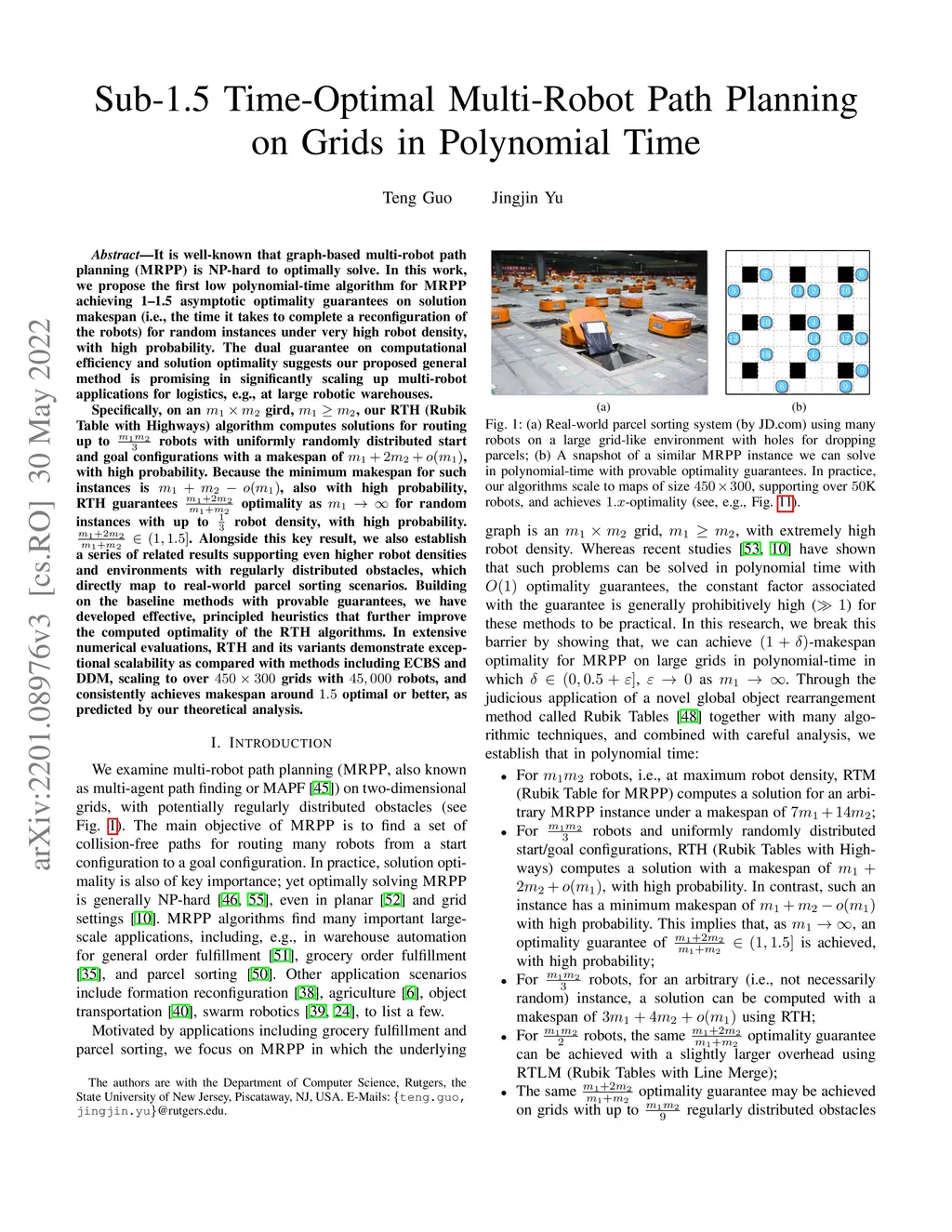
Graph-based multi-robot path planning (MRPP) is NP-hard to optimally solve. In this work, we propose the first low polynomial-time algorithm for MRPP achieving 1--1.5 asymptotic optimality guarantees on solution makespan for random instances under very high robot density. Specifically, on an gird, , our RTH (Rubik Table with Highways) algorithm computes solutions for routing up to robots with uniformly randomly distributed start and goal configurations with a makespan of , with high probability. Because the minimum makespan for such instances is , also with high probability, RTH guarantees optimality as for random instances with up to robot density, with high probability. . Alongside the above-mentioned key result, we also establish: (1) for completely filled grids, i.e., robots, any MRPP instance may be solved in polynomial time under a makespan of , (2) for robots, RTH solves arbitrary MRPP instances with makespan of , (3) for robots, a variation of RTH solves a random MRPP instance with the same 1-1.5 optimality guarantee, and (4) the same optimality guarantee holds for regularly distributed obstacles at density together with randomly distributed robots; such settings directly map to real-world parcel sorting scenarios. In extensive numerical evaluations, RTH and its variants demonstrate exceptional scalability as compared with methods including ECBS and DDM, scaling to over grids with robots, and consistently achieves makespan around optimal or better, as predicted by our theoretical analysis.
View on arXiv