
Rethinking Open-Set Object Detection: Issues, a New Formulation, and Taxonomy
- ObjD
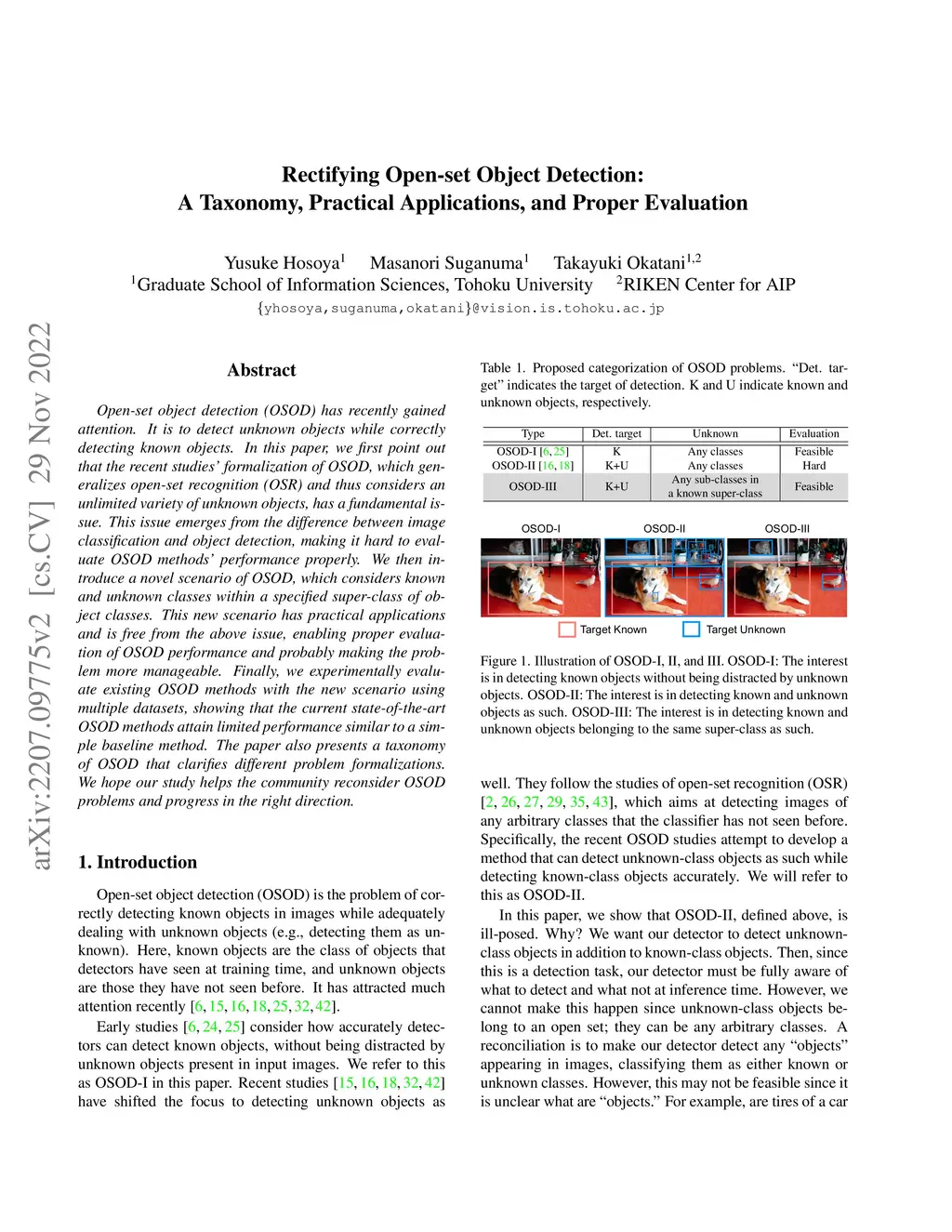
Open-set object detection (OSOD), a task involving the detection of unknown objects while accurately detecting known objects, has recently gained attention. However, we identify a fundamental issue with the problem formulation employed in current OSOD studies. Inherent to object detection is knowing "what to detect," which contradicts the idea of identifying "unknown" objects. This sets OSOD apart from open-set recognition (OSR). This contradiction complicates a proper evaluation of methods' performance, a fact that previous studies have overlooked. Next, we propose a novel formulation wherein detectors are required to detect both known and unknown classes within specified super-classes of object classes. This new formulation is free from the aforementioned issues and has practical applications. Finally, we design benchmark tests utilizing existing datasets and report the experimental evaluation of existing OSOD methods. The results show that existing methods fail to accurately detect unknown objects due to misclassification of known and unknown classes rather than incorrect bounding box prediction. As a byproduct, we introduce a taxonomy of OSOD, resolving confusion prevalent in the literature. We anticipate that our study will encourage the research community to reconsider OSOD and facilitate progress in the right direction.
View on arXiv