
Theory of Mind May Have Spontaneously Emerged in Large Language Models
- LLMAGLRM
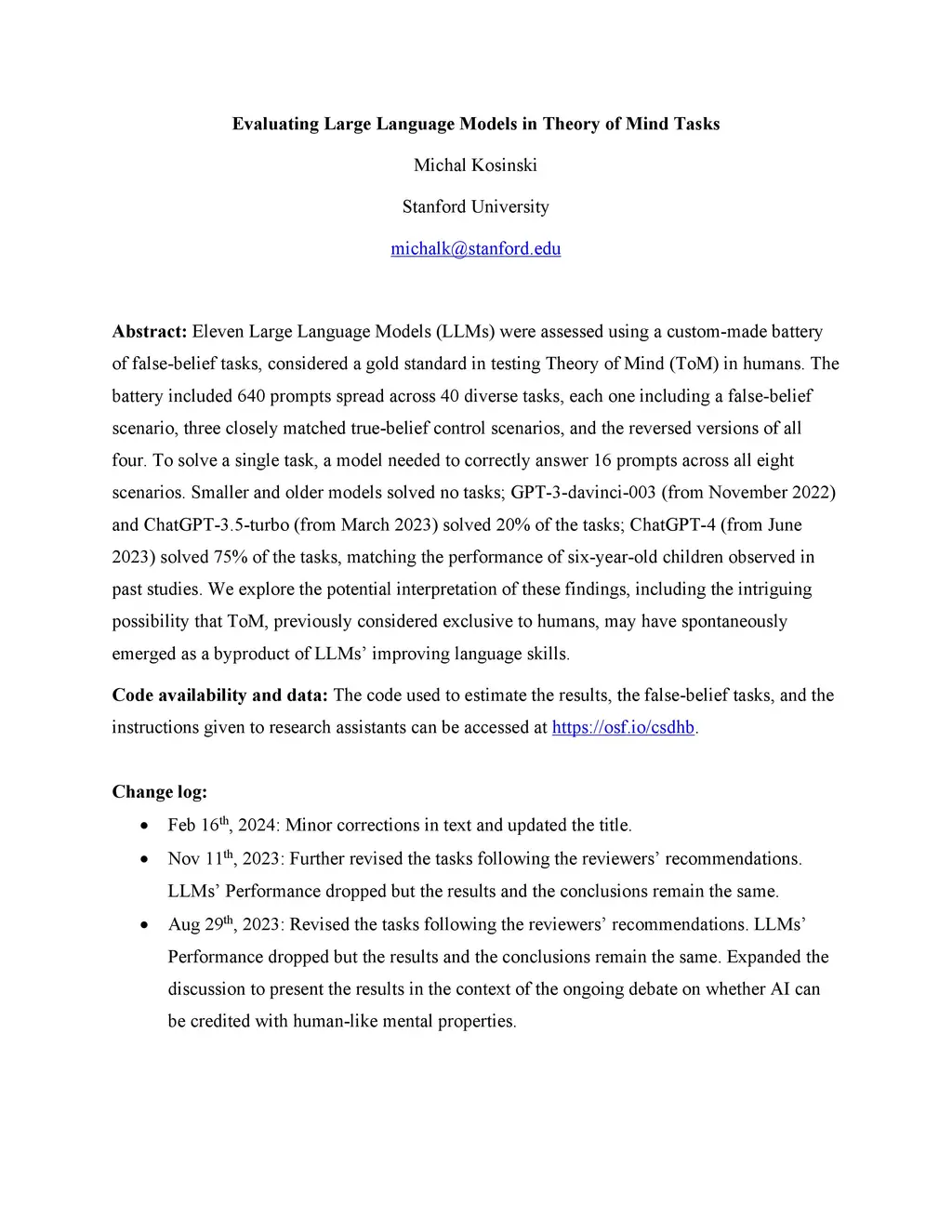
Theory of mind (ToM), or the ability to impute unobservable mental states to others, is central to human social interactions, communication, empathy, self-consciousness, and morality. We tested several language models using 40 classic false-belief tasks widely used to test ToM in humans. The models published before 2020 showed virtually no ability to solve ToM tasks. Yet, the first version of GPT-3 ("davinci-001"), published in May 2020, solved about 40% of false-belief tasks-performance comparable with 3.5-year-old children. Its second version ("davinci-002"; January 2022) solved 70% of false-belief tasks, performance comparable with six-year-olds. Its most recent version, GPT-3.5 ("davinci-003"; November 2022), solved 90% of false-belief tasks, at the level of seven-year-olds. GPT-4 published in March 2023 solved nearly all the tasks (95%). These findings suggest that ToM-like ability (thus far considered to be uniquely human) may have spontaneously emerged as a byproduct of language models' improving language skills.
View on arXiv