
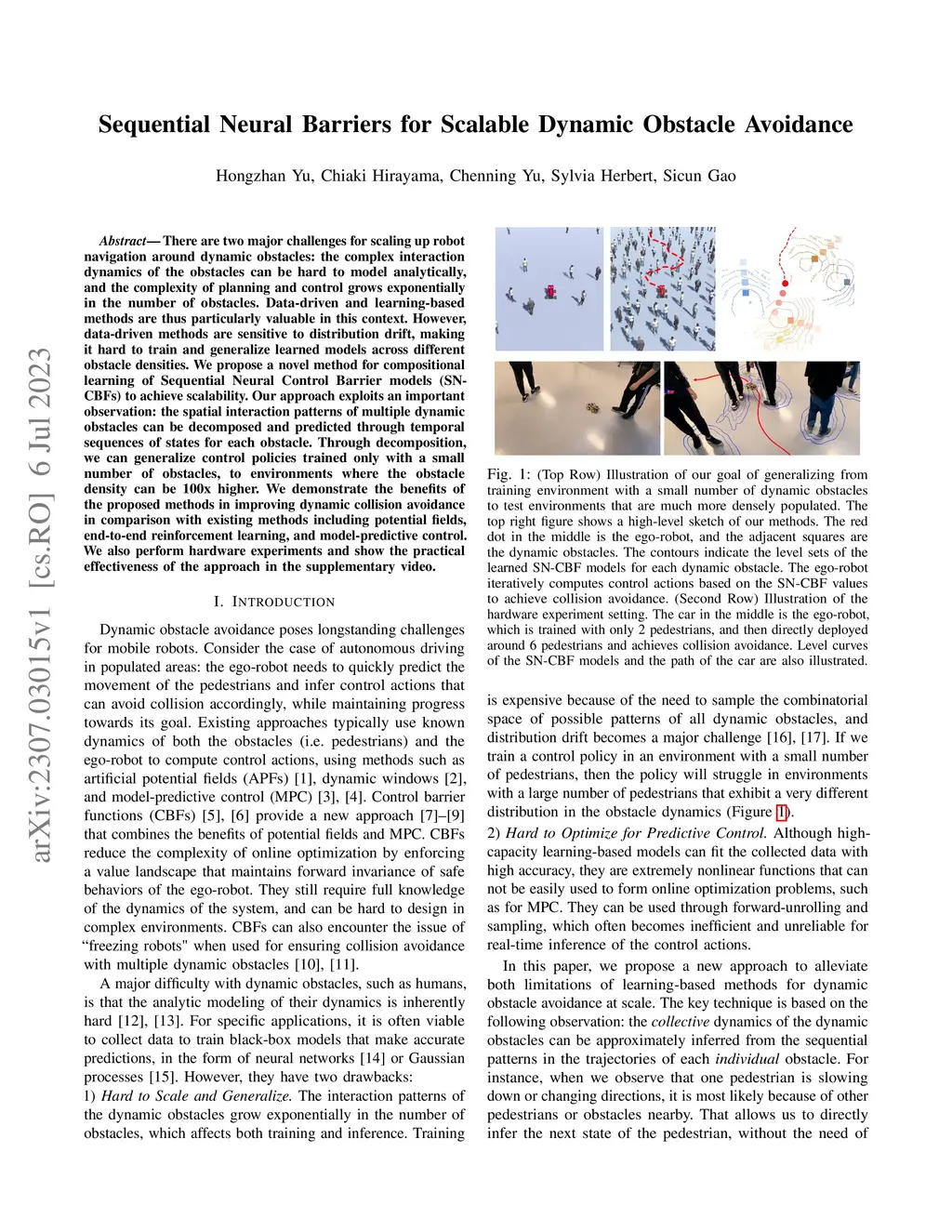
There are two major challenges for scaling up robot navigation around dynamic obstacles: the complex interaction dynamics of the obstacles can be hard to model analytically, and the complexity of planning and control grows exponentially in the number of obstacles. Data-driven and learning-based methods are thus particularly valuable in this context. However, data-driven methods are sensitive to distribution drift, making it hard to train and generalize learned models across different obstacle densities. We propose a novel method for compositional learning of Sequential Neural Control Barrier models (SNCBFs) to achieve scalability. Our approach exploits an important observation: the spatial interaction patterns of multiple dynamic obstacles can be decomposed and predicted through temporal sequences of states for each obstacle. Through decomposition, we can generalize control policies trained only with a small number of obstacles, to environments where the obstacle density can be 100x higher. We demonstrate the benefits of the proposed methods in improving dynamic collision avoidance in comparison with existing methods including potential fields, end-to-end reinforcement learning, and model-predictive control. We also perform hardware experiments and show the practical effectiveness of the approach in the supplementary video.
View on arXiv