
Learning Deployable Locomotion Control via Differentiable Simulation
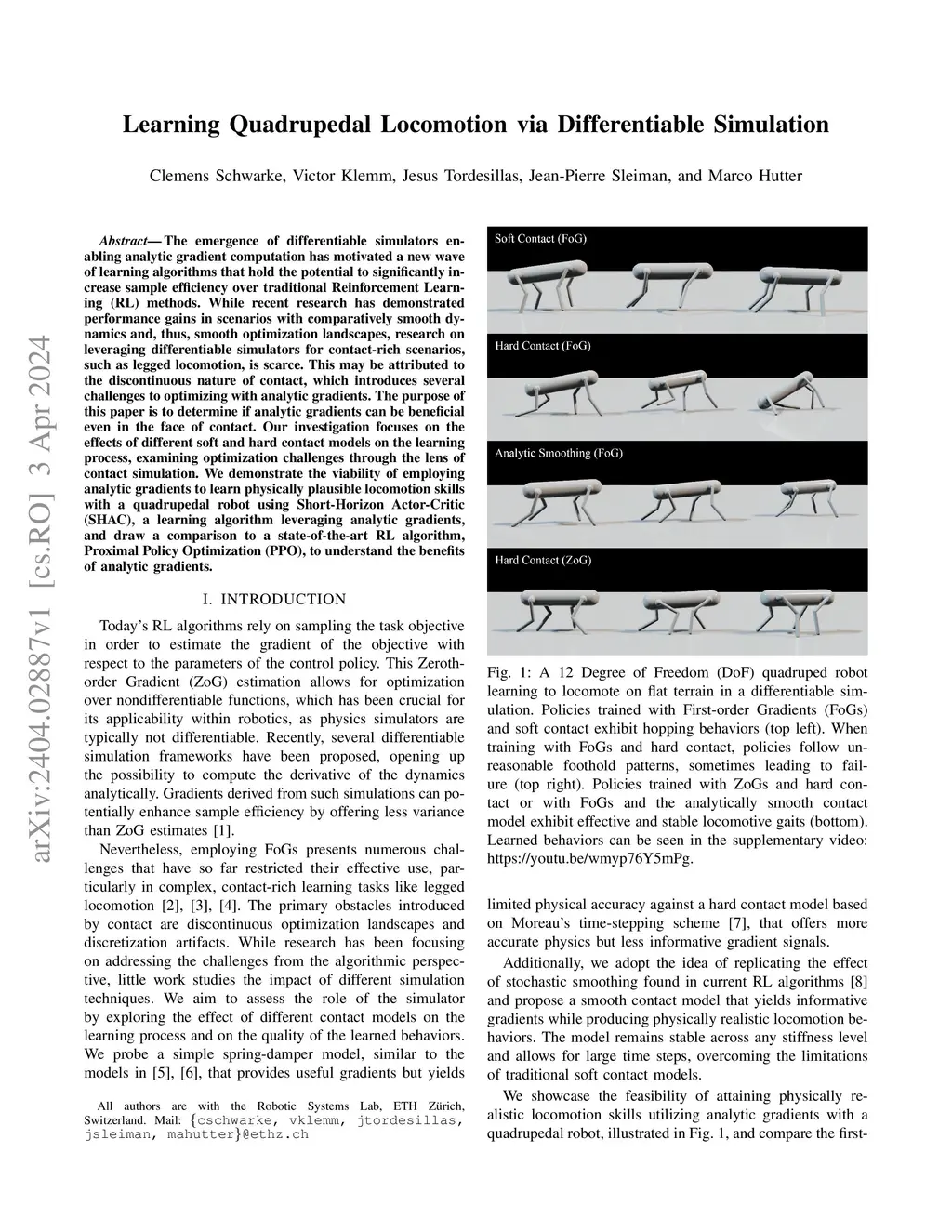
Differentiable simulators promise to improve sample efficiency in robot learning by providing analytic gradients of the system dynamics. Yet, their application to contact-rich tasks like locomotion is complicated by the inherently non-smooth nature of contact, impeding effective gradient-based optimization. Existing works thus often rely on soft contact models that provide smooth gradients but lack physical accuracy, constraining results to simulation. To address this limitation, we propose a differentiable contact model designed to provide informative gradients while maintaining high physical fidelity. We demonstrate the efficacy of our approach by training a quadrupedal locomotion policy within our differentiable simulator leveraging analytic gradients and successfully transferring the learned policy zero-shot to the real world. To the best of our knowledge, this represents the first successful sim-to-real transfer of a legged locomotion policy learned entirely within a differentiable simulator, establishing the feasibility of using differentiable simulation for real-world locomotion control.
View on arXiv