
Experimental Comparison of Whole-Body Control Formulations for Humanoid Robots in Task Acceleration and Task Force Spaces
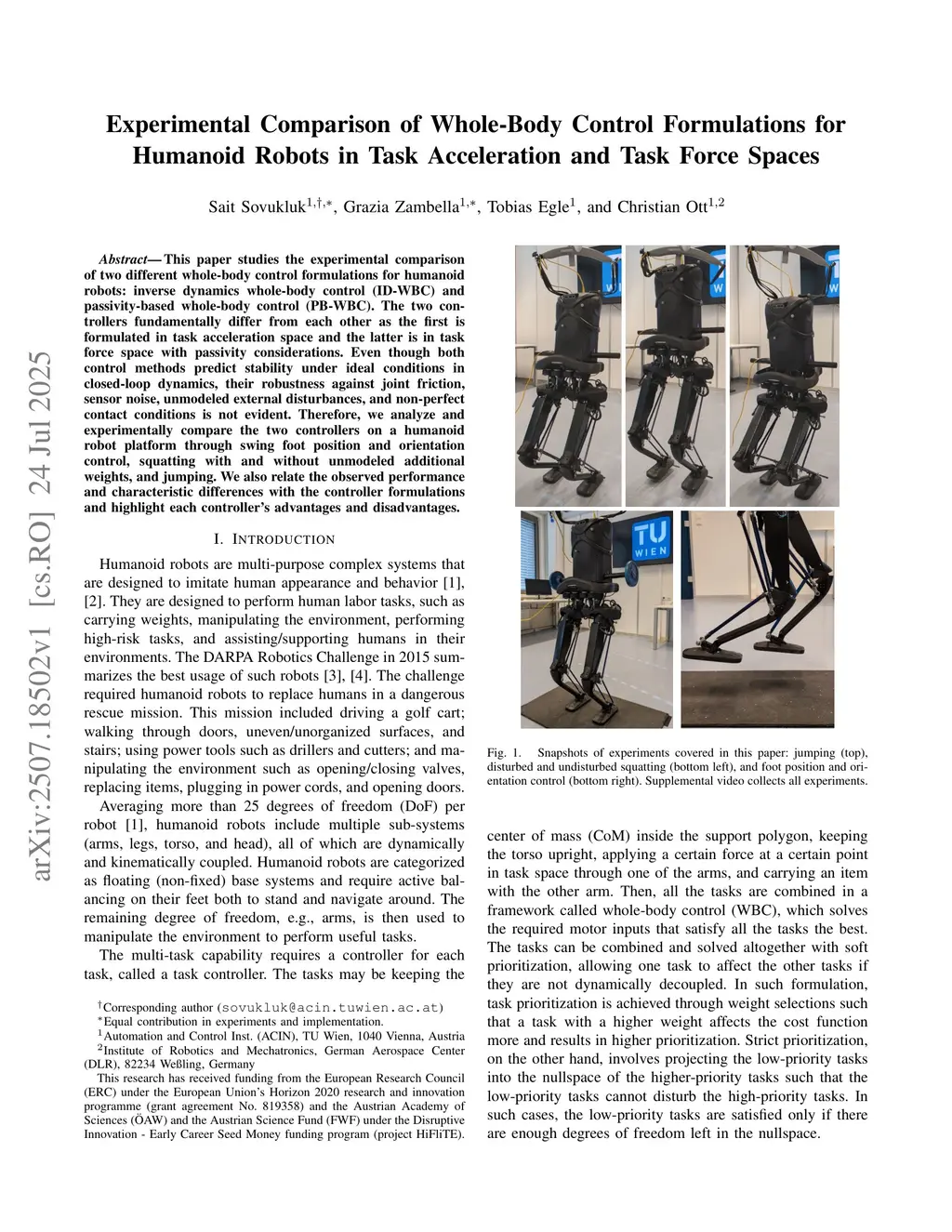
This paper studies the experimental comparison of two different whole-body control formulations for humanoid robots: inverse dynamics whole-body control (ID-WBC) and passivity-based whole-body control (PB-WBC). The two controllers fundamentally differ from each other as the first is formulated in task acceleration space and the latter is in task force space with passivity considerations. Even though both control methods predict stability under ideal conditions in closed-loop dynamics, their robustness against joint friction, sensor noise, unmodeled external disturbances, and non-perfect contact conditions is not evident. Therefore, we analyze and experimentally compare the two controllers on a humanoid robot platform through swing foot position and orientation control, squatting with and without unmodeled additional weights, and jumping. We also relate the observed performance and characteristic differences with the controller formulations and highlight each controller's advantages and disadvantages.
View on arXiv