
Mind and Motion Aligned: A Joint Evaluation IsaacSim Benchmark for Task Planning and Low-Level Policies in Mobile Manipulation
- LM&Ro
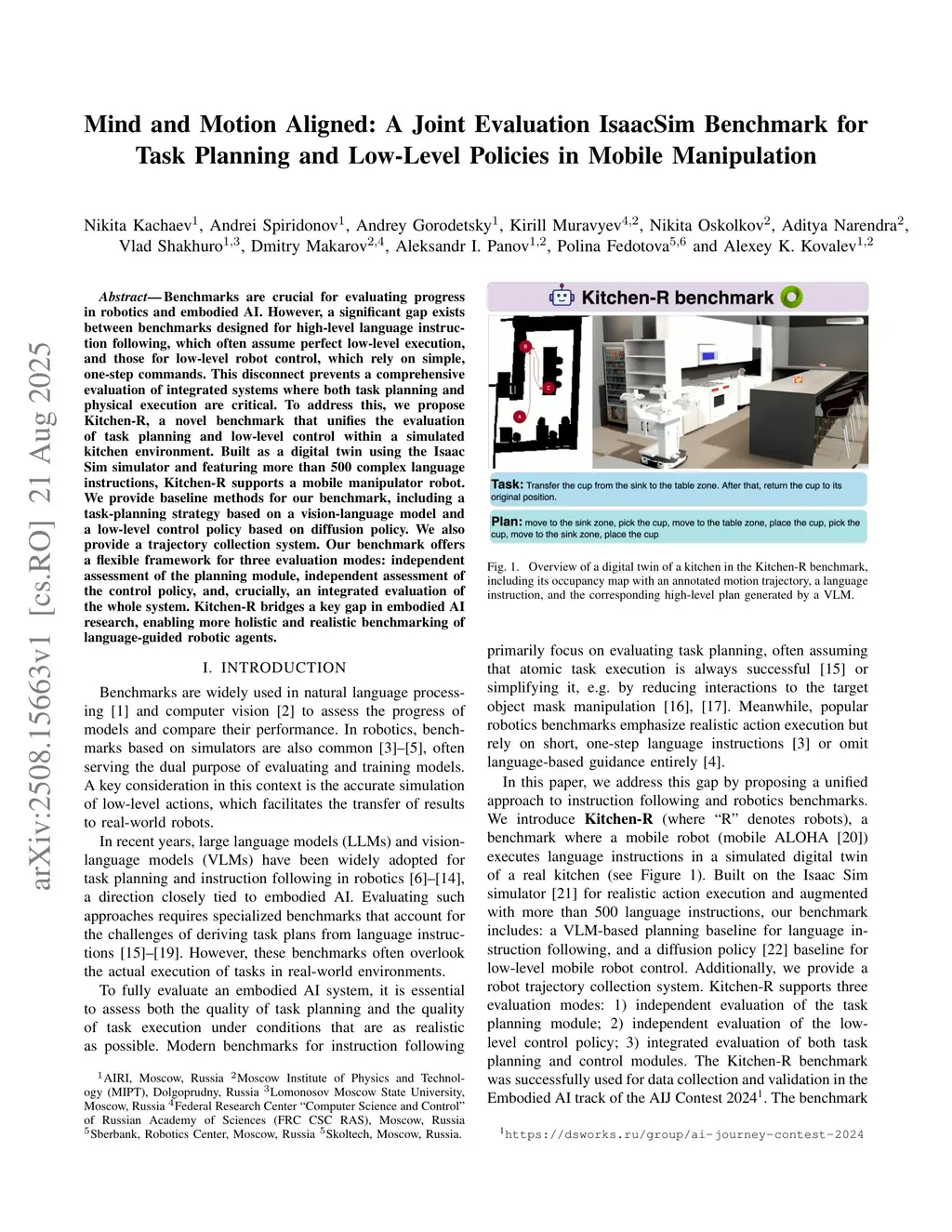
Benchmarks are crucial for evaluating progress in robotics and embodied AI. However, a significant gap exists between benchmarks designed for high-level language instruction following, which often assume perfect low-level execution, and those for low-level robot control, which rely on simple, one-step commands. This disconnect prevents a comprehensive evaluation of integrated systems where both task planning and physical execution are critical. To address this, we propose Kitchen-R, a novel benchmark that unifies the evaluation of task planning and low-level control within a simulated kitchen environment. Built as a digital twin using the Isaac Sim simulator and featuring more than 500 complex language instructions, Kitchen-R supports a mobile manipulator robot. We provide baseline methods for our benchmark, including a task-planning strategy based on a vision-language model and a low-level control policy based on diffusion policy. We also provide a trajectory collection system. Our benchmark offers a flexible framework for three evaluation modes: independent assessment of the planning module, independent assessment of the control policy, and, crucially, an integrated evaluation of the whole system. Kitchen-R bridges a key gap in embodied AI research, enabling more holistic and realistic benchmarking of language-guided robotic agents.
View on arXiv