
PACE: Physics Augmentation for Coordinated End-to-end Reinforcement Learning toward Versatile Humanoid Table Tennis
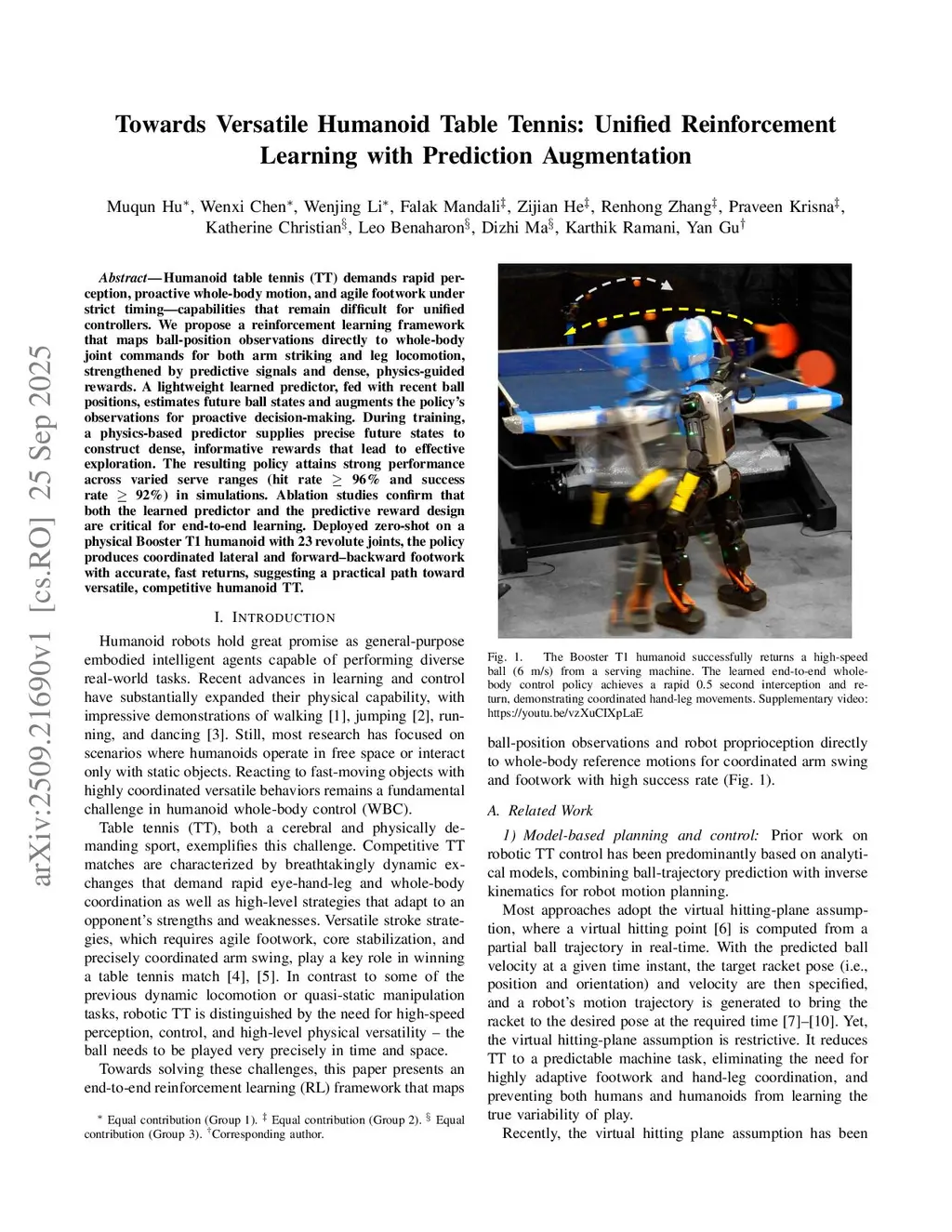
Humanoid table tennis (TT) demands rapid perception, proactive whole-body motion, and agile footwork under strict timing--capabilities that remain difficult for end-to-end control policies. We propose a reinforcement learning (RL) framework that maps ball-position observations directly to whole-body joint commands for both arm striking and leg locomotion, strengthened by predictive signals and dense, physics-guided rewards. A lightweight learned predictor, fed with recent ball positions, estimates future ball states and augments the policy's observations for proactive decision-making. During training, a physics-based predictor supplies precise future states to construct dense, informative rewards that lead to effective exploration. The resulting policy attains strong performance across varied serve ranges (hit rate96% and success rate92%) in simulations. Ablation studies confirm that both the learned predictor and the predictive reward design are critical for end-to-end learning. Deployed zero-shot on a physical Booster T1 humanoid with 23 revolute joints, the policy produces coordinated lateral and forward-backward footwork with accurate, fast returns, suggesting a practical path toward versatile, competitive humanoid TT. We have open-sourced our RL training code at:this https URL
View on arXiv