
HeLoM: Hierarchical Learning for Whole-Body Loco-Manipulation in Hexapod Robot
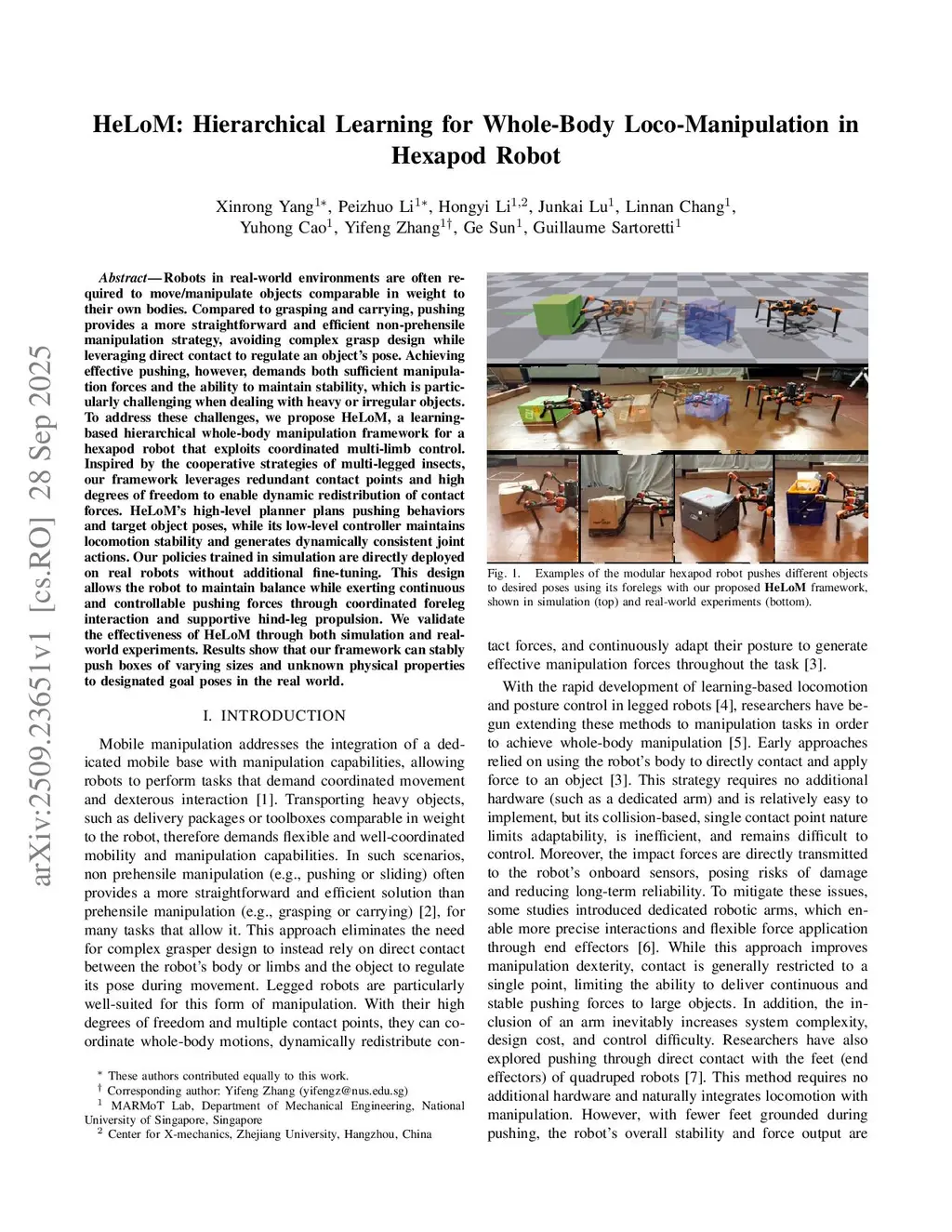
Robots in real-world environments are often required to move/manipulate objects comparable in weight to their own bodies. Compared to grasping and carrying, pushing provides a more straightforward and efficient non-prehensile manipulation strategy, avoiding complex grasp design while leveraging direct contact to regulate an object's pose. Achieving effective pushing, however, demands both sufficient manipulation forces and the ability to maintain stability, which is particularly challenging when dealing with heavy or irregular objects. To address these challenges, we propose HeLoM, a learning-based hierarchical whole-body manipulation framework for a hexapod robot that exploits coordinated multi-limb control. Inspired by the cooperative strategies of multi-legged insects, our framework leverages redundant contact points and high degrees of freedom to enable dynamic redistribution of contact forces. HeLoM's high-level planner plans pushing behaviors and target object poses, while its low-level controller maintains locomotion stability and generates dynamically consistent joint actions. Our policies trained in simulation are directly deployed on real robots without additional fine-tuning. This design allows the robot to maintain balance while exerting continuous and controllable pushing forces through coordinated foreleg interaction and supportive hind-leg propulsion. We validate the effectiveness of HeLoM through both simulation and real-world experiments. Results show that our framework can stably push boxes of varying sizes and unknown physical properties to designated goal poses in the real world.
View on arXiv