
CASL: Curvature-Augmented Self-supervised Learning for 3D Anomaly Detection
- 3DPC
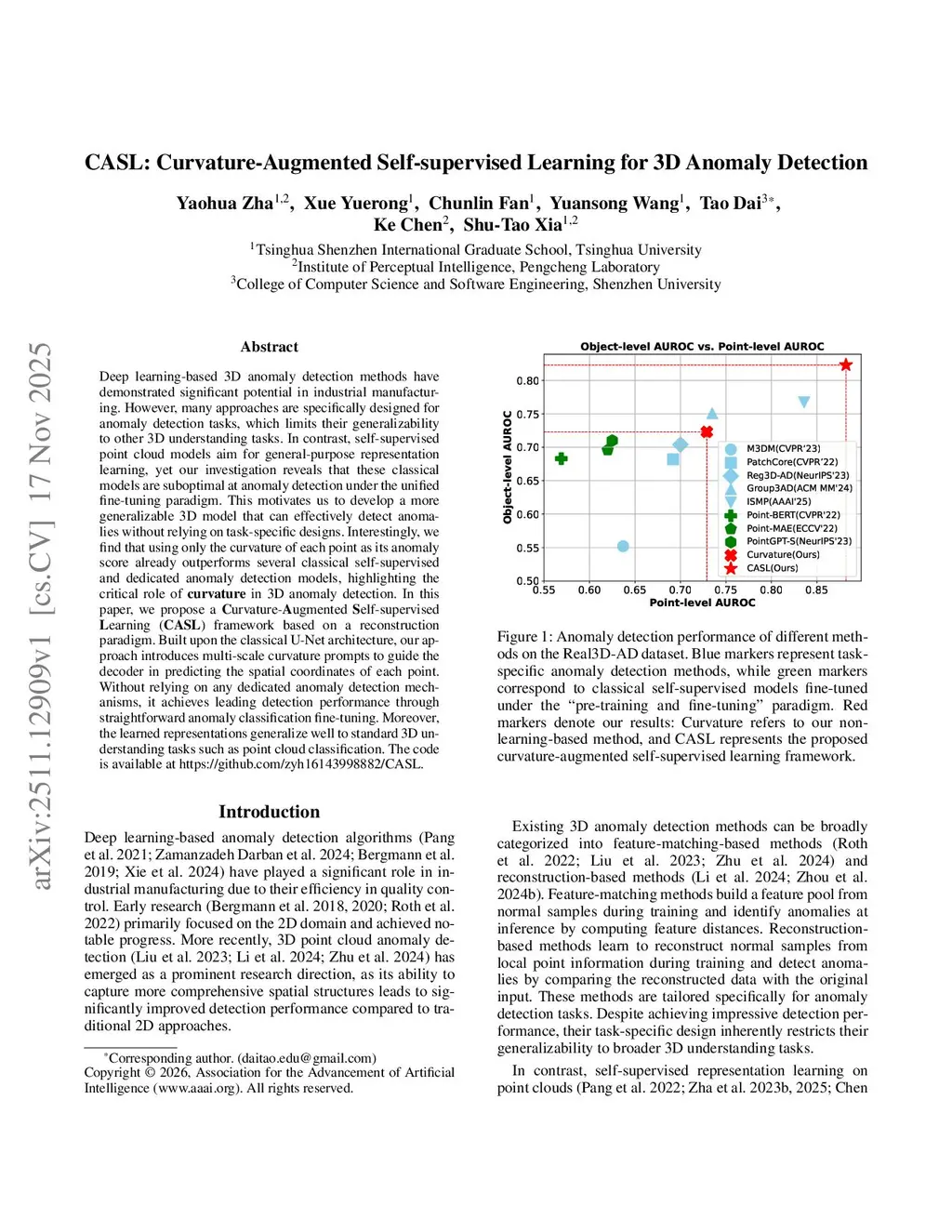
Deep learning-based 3D anomaly detection methods have demonstrated significant potential in industrial manufacturing. However, many approaches are specifically designed for anomaly detection tasks, which limits their generalizability to other 3D understanding tasks. In contrast, self-supervised point cloud models aim for general-purpose representation learning, yet our investigation reveals that these classical models are suboptimal at anomaly detection under the unified fine-tuning paradigm. This motivates us to develop a more generalizable 3D model that can effectively detect anomalies without relying on task-specific designs. Interestingly, we find that using only the curvature of each point as its anomaly score already outperforms several classical self-supervised and dedicated anomaly detection models, highlighting the critical role of curvature in 3D anomaly detection. In this paper, we propose a Curvature-Augmented Self-supervised Learning (CASL) framework based on a reconstruction paradigm. Built upon the classical U-Net architecture, our approach introduces multi-scale curvature prompts to guide the decoder in predicting the spatial coordinates of each point. Without relying on any dedicated anomaly detection mechanisms, it achieves leading detection performance through straightforward anomaly classification fine-tuning. Moreover, the learned representations generalize well to standard 3D understanding tasks such as point cloud classification. The code is available atthis https URL.
View on arXiv