
City Navigation in the Wild: Exploring Emergent Navigation from Web-Scale Knowledge in MLLMs
- LLMAGLM&RoLRM
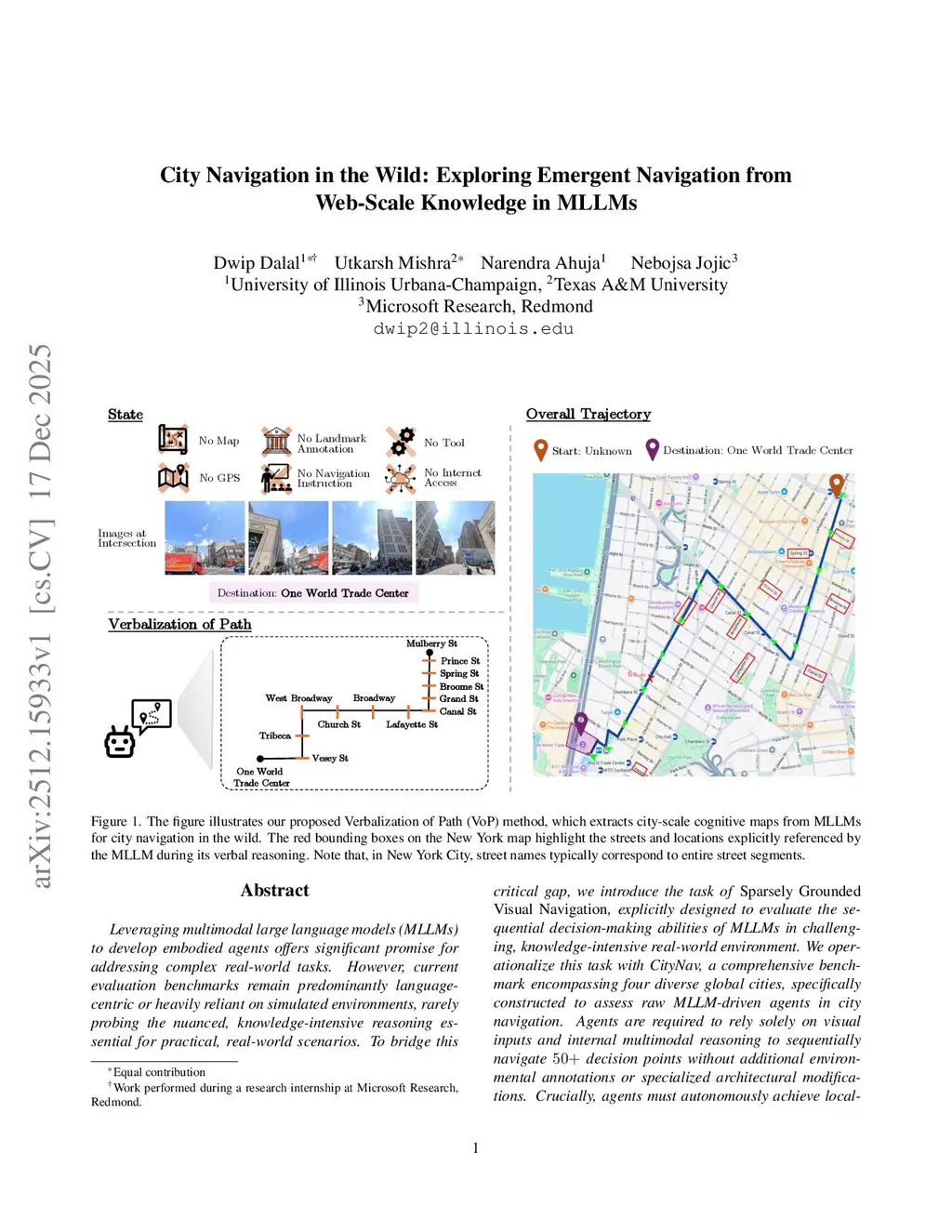
Leveraging multimodal large language models (MLLMs) to develop embodied agents offers significant promise for addressing complex real-world tasks. However, current evaluation benchmarks remain predominantly language-centric or heavily reliant on simulated environments, rarely probing the nuanced, knowledge-intensive reasoning essential for practical, real-world scenarios. To bridge this critical gap, we introduce the task of Sparsely Grounded Visual Navigation, explicitly designed to evaluate the sequential decision-making abilities of MLLMs in challenging, knowledge-intensive real-world environment. We operationalize this task with CityNav, a comprehensive benchmark encompassing four diverse global cities, specifically constructed to assess raw MLLM-driven agents in city navigation. Agents are required to rely solely on visual inputs and internal multimodal reasoning to sequentially navigate 50+ decision points without additional environmental annotations or specialized architectural modifications. Crucially, agents must autonomously achieve localization through interpreting city-specific cues and recognizing landmarks, perform spatial reasoning, and strategically plan and execute routes to their destinations. Through extensive evaluations, we demonstrate that current state-of-the-art MLLMs, reasoning techniques (e.g., GEPA, chain-of-thought, reflection) and competitive baseline PReP significantly underperform in this challenging setting. To address this, we propose Verbalization of Path(VoP), which explicitly grounds the agent's internal reasoning by probing city-scale cognitive maps (key landmarks and directions toward the destination) from the MLLM, substantially enhancing navigation success. Project Webpage:this https URL
View on arXiv