
Green-VLA: Staged Vision-Language-Action Model for Generalist Robots
- LM&Ro
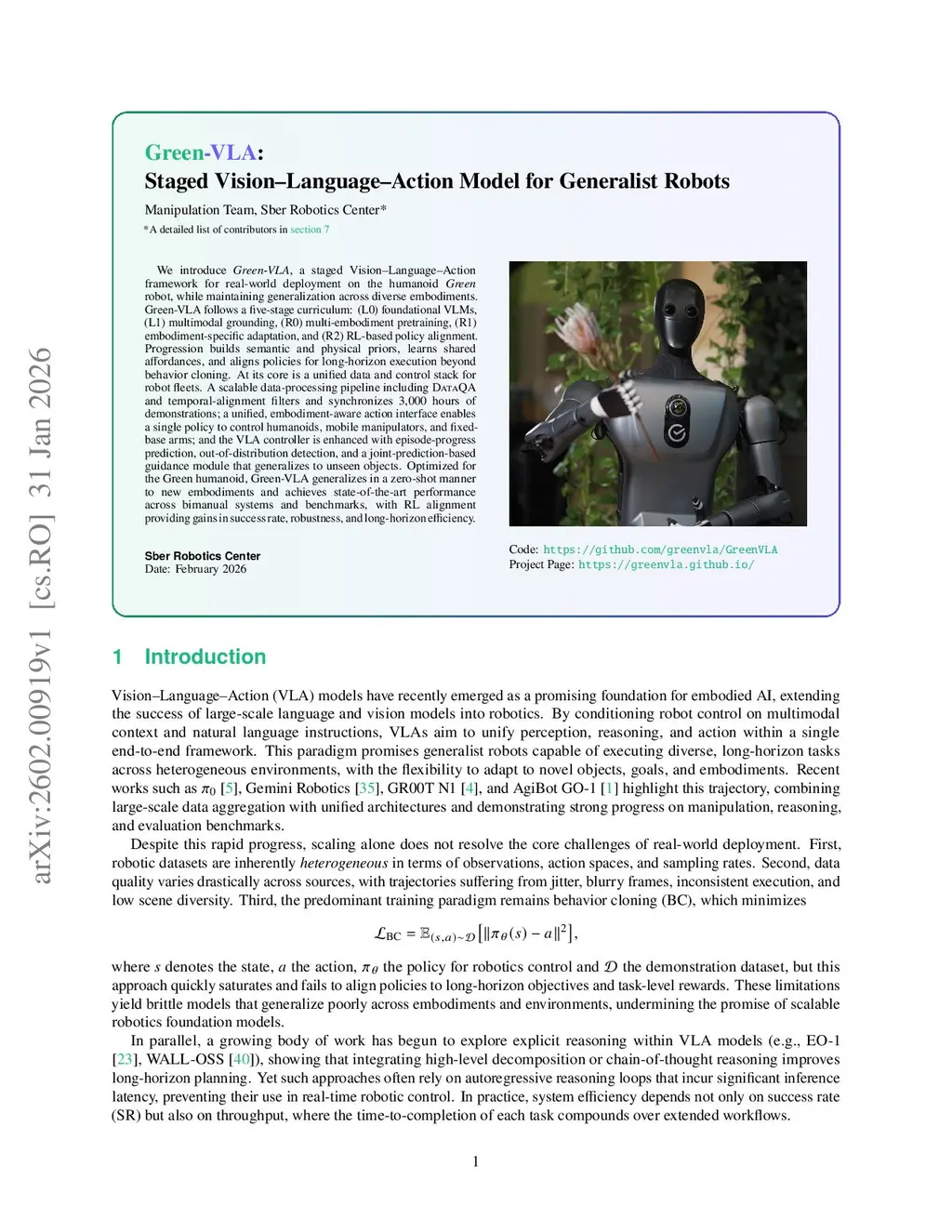
We introduce Green-VLA, a staged Vision-Language-Action (VLA) framework for real-world deployment on the Green humanoid robot while maintaining generalization across diverse embodiments. Green-VLA follows a five stage curriculum: (L0) foundational VLMs, (L1) multimodal grounding, (R0) multi-embodiment pretraining, (R1) embodiment-specific adaptation, and (R2) reinforcement-learning (RL) policy alignment. We couple a scalable data-processing pipeline (3,000 hours of demonstrations) with temporal alignment and quality filtering, and use a unified, embodiment-aware action interface enabling a single policy to control humanoids, mobile manipulators, and fixed-base arms. At inference, the VLA controller is enhanced with episode-progress prediction, out-of-distribution detection, and joint-prediction-based guidance to improve safety and precise target selection. Experiments on Simpler BRIDGE WidowX and CALVIN ABC-D, as well as real-robot evaluations, show strong generalization and performance gains from RL alignment in success rate, robustness, and long-horizon efficiency.
View on arXiv