
VGGT-Det: Mining VGGT Internal Priors for Sensor-Geometry-Free Multi-View Indoor 3D Object Detection
- ViT3DPC
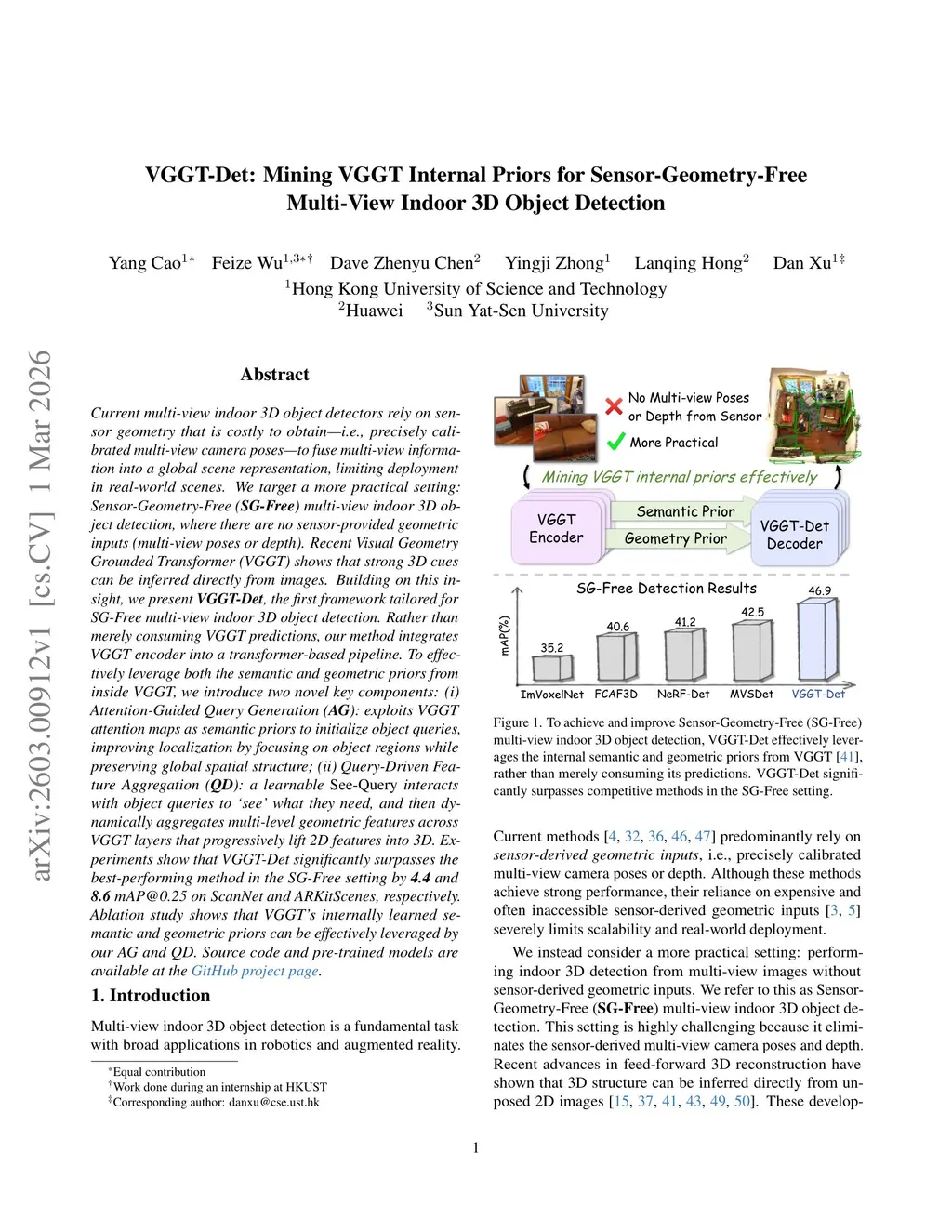
Current multi-view indoor 3D object detectors rely on sensor geometry that is costly to obtain (i.e., precisely calibrated multi-view camera poses) to fuse multi-view information into a global scene representation, limiting deployment in real-world scenes. We target a more practical setting: Sensor-Geometry-Free (SG-Free) multi-view indoor 3D object detection, where there are no sensor-provided geometric inputs (multi-view poses or depth). Recent Visual Geometry Grounded Transformer (VGGT) shows that strong 3D cues can be inferred directly from images. Building on this insight, we present VGGT-Det, the first framework tailored for SG-Free multi-view indoor 3D object detection. Rather than merely consuming VGGT predictions, our method integrates VGGT encoder into a transformer-based pipeline. To effectively leverage both the semantic and geometric priors from inside VGGT, we introduce two novel key components: (i) Attention-Guided Query Generation (AG): exploits VGGT attention maps as semantic priors to initialize object queries, improving localization by focusing on object regions while preserving global spatial structure; (ii) Query-Driven Feature Aggregation (QD): a learnable See-Query interacts with object queries to 'see' what they need, and then dynamically aggregates multi-level geometric features across VGGT layers that progressively lift 2D features into 3D. Experiments show that VGGT-Det significantly surpasses the best-performing method in the SG-Free setting by 4.4 and 8.6 mAP@0.25 on ScanNet and ARKitScenes, respectively. Ablation study shows that VGGT's internally learned semantic and geometric priors can be effectively leveraged by our AG and QD.
View on arXiv