
IGASA: Integrated Geometry-Aware and Skip-Attention Modules for Enhanced Point Cloud Registration
- 3DV3DPC
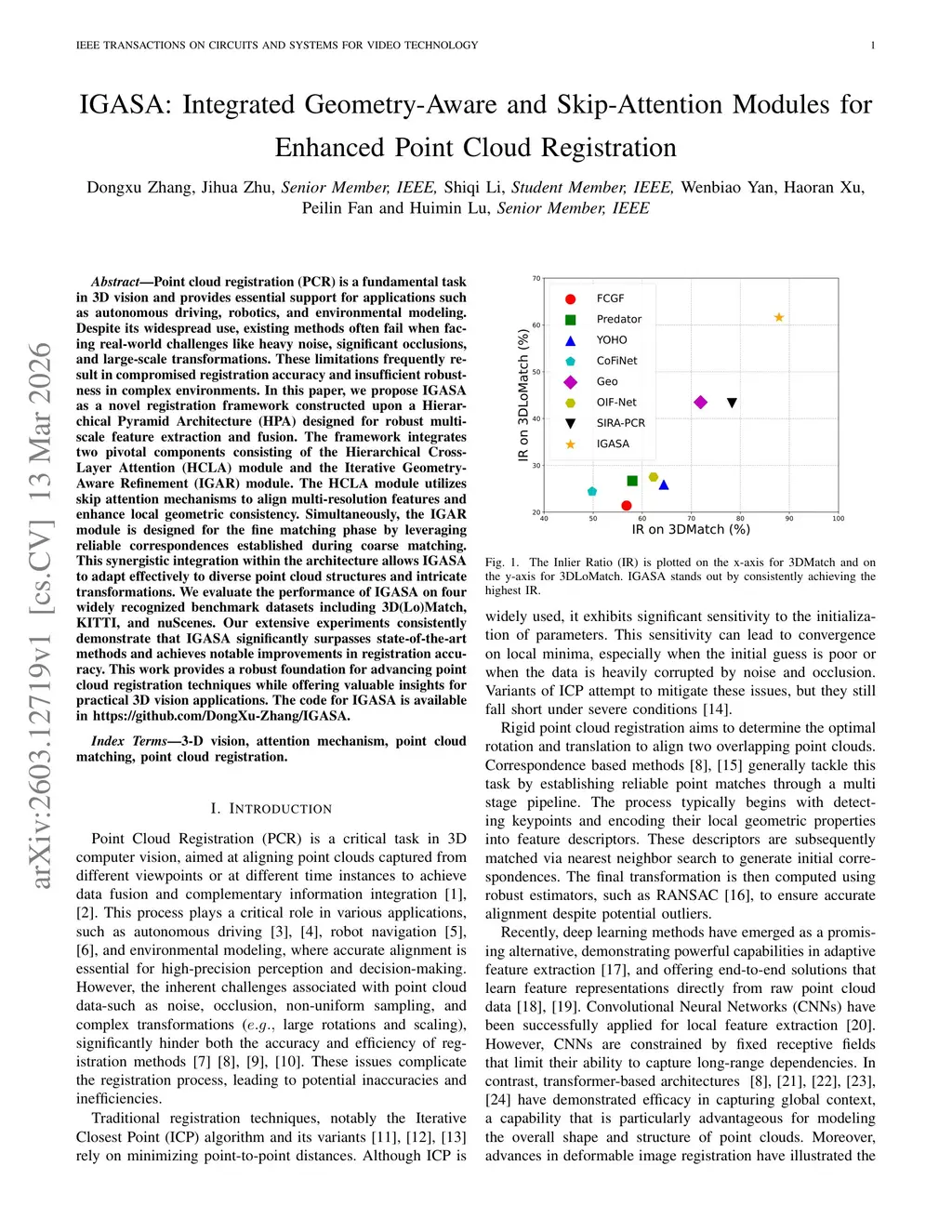
Point cloud registration (PCR) is a fundamental task in 3D vision and provides essential support for applications such as autonomous driving, robotics, and environmental modeling. Despite its widespread use, existing methods often fail when facing real-world challenges like heavy noise, significant occlusions, and large-scale transformations. These limitations frequently result in compromised registration accuracy and insufficient robustness in complex environments. In this paper, we propose IGASA as a novel registration framework constructed upon a Hierarchical Pyramid Architecture (HPA) designed for robust multi-scale feature extraction and fusion. The framework integrates two pivotal components consisting of the Hierarchical Cross-Layer Attention (HCLA) module and the Iterative Geometry-Aware Refinement (IGAR) module. The HCLA module utilizes skip attention mechanisms to align multi-resolution features and enhance local geometric consistency. Simultaneously, the IGAR module is designed for the fine matching phase by leveraging reliable correspondences established during coarse matching. This synergistic integration within the architecture allows IGASA to adapt effectively to diverse point cloud structures and intricate transformations. We evaluate the performance of IGASA on four widely recognized benchmark datasets including 3D(Lo)Match, KITTI, and nuScenes. Our extensive experiments consistently demonstrate that IGASA significantly surpasses state-of-the-art methods and achieves notable improvements in registration accuracy. This work provides a robust foundation for advancing point cloud registration techniques while offering valuable insights for practical 3D vision applications. The code for IGASA is available in \href{this https URL}{this https URL}.
View on arXiv